


How to Choose the Right Sheet Metal Design Services Company
To choose the right sheet metal design services company, evaluate its design-for-manufacturing (DFM) expertise, calibration to your fabricator's bend table, native CAD capabilities, drawing documentation, and revision control. Then review sample deliverables, relevant industry experience, communication, data security, intellectual property terms, and pricing. A small, paid pilot can help you compare providers using the same part and requirements.
By DevWorks Automation Team · October 13, 2026 · 12 min read
To choose the right sheet metal design services company, evaluate its design-for-manufacturing (DFM) expertise, calibration to your fabricator's bend table, native CAD capabilities, drawing documentation, and revision control. Then review sample deliverables, relevant industry experience, communication, data security, intellectual property terms, and pricing. A small, paid pilot can help you compare providers using the same part and requirements.
The sections below explain each criterion, provide a scorecard and questions to ask, and break down the factors that affect cost.
What Does a Sheet Metal Design Services Company Do?
A sheet metal design services company turns a concept, sketch, legacy drawing or 3D scan into manufacturable sheet metal data: parametric 3D models, flat patterns, assemblies, drawings and bills of materials (BOMs). It does not cut or bend metal. Its job is to make sure the fabricator can build the part right the first time.
Typical deliverables include:
- Parametric 3D models with correct gauge, bend radii, reliefs and features, built natively in tools such as SolidWorks, Autodesk Inventor or Siemens NX.
- Flat patterns and DXF files with bend lines and notes, ready for laser, punch or CAM software.
- Weldments and assemblies with gussets, frames and a BOM that updates as the design changes.
- Manufacturing drawings with dimensions, tolerances, GD&T, weld symbols, finish notes, and revision blocks.
- BOMs and cut lists your ERP or purchasing team can use directly.
- Reverse engineering of existing parts from samples or scans into clean parametric models.
Design Partner vs Fabrication Partner
The two roles overlap, which is why buyers often evaluate them with the same checklist. They need different skills.
| Sheet metal design services company | Sheet metal fabrication company | |
|---|---|---|
| Main output | Models, flat patterns, drawings, BOMs | Finished parts and assemblies |
| When you engage them | Concept through release, and every engineering change | After drawings are released |
| Core skills | CAD, DFM, tolerancing, drawing standards, data management | Cutting, forming, welding, finishing, inspection |
| Evaluate them on | Design accuracy, documentation quality, change control | Equipment, capacity, certifications, lead time |
| Cost of a weak partner | Errors that every downstream step inherits | Poor part quality or late delivery |
Some fabricators offer in-house design, and that can work well for simple parts built only in their shop. A dedicated design partner makes more sense when you use several fabricators, need designs you fully own, or run a product family with many variants.
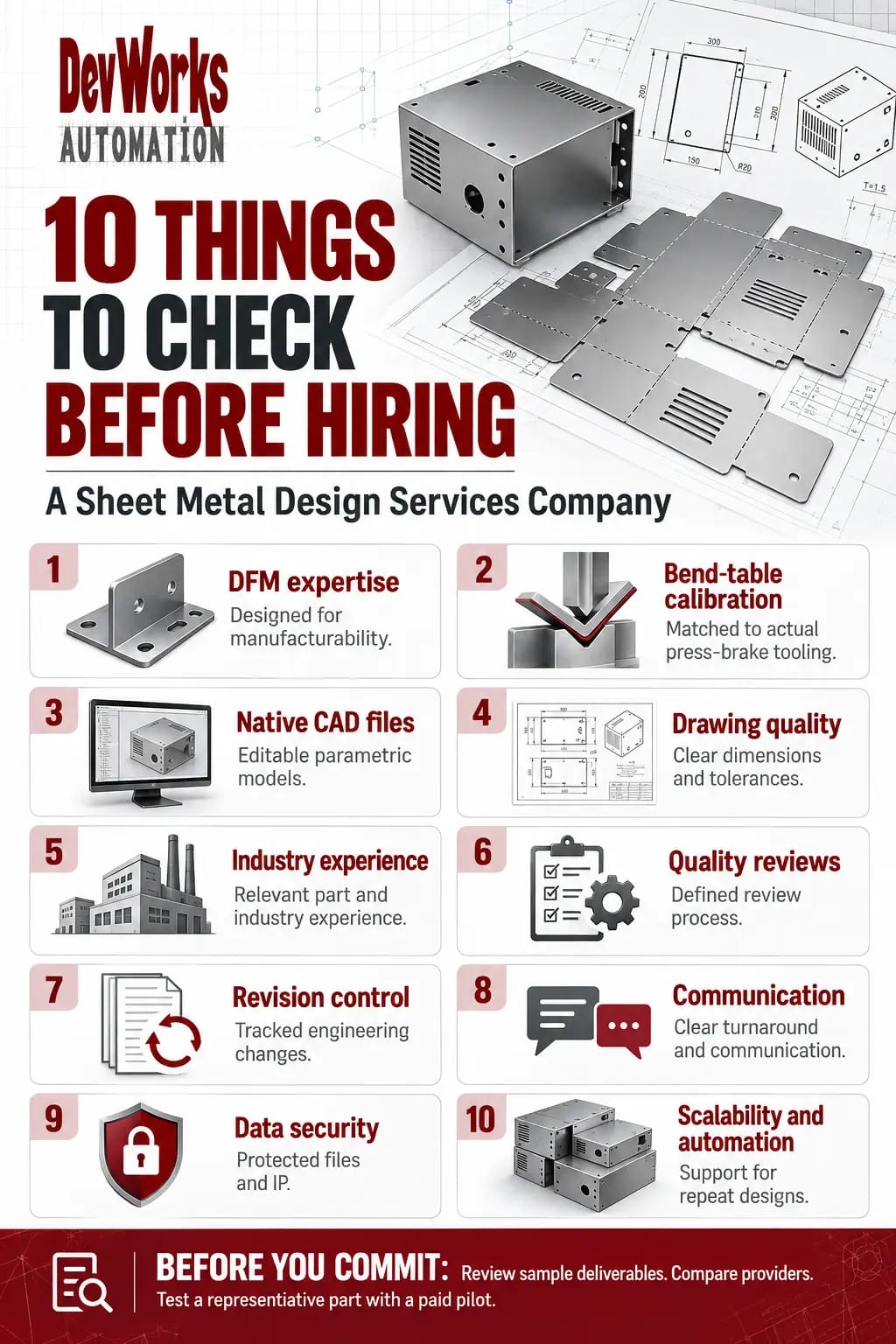
The 10-Point Checklist for Choosing a Sheet Metal Design Partner
The best sheet metal design partners prove their value through deliverables, not claims. Use these ten criteria to separate a CAD drafting vendor from a partner who understands how sheet metal is made.
1. Real Design-for-Manufacturing (DFM) Knowledge
A good sheet metal designer checks every part against fabrication rules before it reaches a drawing. That includes bend radius relative to material thickness, hole-to-edge and hole-to-bend distances, bend and corner reliefs, minimum flange length, tool clearance, grain direction, hardware insertion clearance and weld access.
Ask whether they use a written DFM checklist and when it runs. A team that checks manufacturability only after a fabricator complains is doing rework, not design.
2. Calibration to Your Fabricator's Bend Table
Flat pattern accuracy depends on the K-factor, bend radius and bend deduction matching the press brake tooling that will form the part. CAD defaults are generic starting points. If the design partner never asks about your fabricator's tooling, the flat pattern can be off, and formed dimensions will drift out of tolerance.
The right partner asks for your bend table or tooling data at the start of the project and builds it into the model template.
3. Native CAD Fit and Clean Model Structure
Your partner should work in your CAD system and hand back native files, not just neutral STEP or IGES exports. Native parametric models keep the feature tree, sheet metal definitions and design intent, so your team can edit them later.
Also ask how they handle imported or legacy geometry. Rebuilding a non-parametric solid as true parametric sheet metal takes more effort, but it makes future changes faster and more reliable.
4. Drawing Standards and Documentation Quality
A drawing is only useful if the shop can interpret it without repeated clarification. Confirm that the partner follows the standards your organization and customer require, and that weld symbols, finish notes and revision blocks follow your conventions. ASME Y14.5 covers geometric dimensioning and tolerancing (GD&T). ISO 2768-1 covers general tolerances for linear and angular dimensions where applicable. ISO 22081:2021 covers general geometric and size specifications. Confirm the applicable standard and edition for each project rather than assuming one reference covers every tolerancing requirement.
The fastest test is to ask for a redacted sample drawing pack for a part similar to yours.
5. Relevant Industry and Product Experience
An electrical enclosure, a commercial kitchen station and an HVAC transition each bring different rules. Enclosures need knockouts, gasket grooves, and ingress ratings considered. Food-grade equipment needs hygienic radii and weld finishing. Ductwork often involves many variable-size parts.
Ask for examples of parts with similar complexity, materials, and volume. Similar experiences shorten the learning curve and reduce review cycles.
6. A Defined Review and Quality Process
Quality in design work comes from a repeatable process, not individual heroics. Look for defined checkpoints: input review, model build, DFM audit, drawing check and a final release review, with a second person checking work before it ships.
Ask who checks the drawings, what they check against, and how redlines from your team are logged and closed.
7. Change Control and Revision Management
Engineering changes are where outsourced design most often breaks down. The partner should manage revisions with clear revision blocks, a documented engineering change notice (ECN) process, and, where you use one, check-in to your PDM or PLM vault.
Ask how a change to one part is propagated through the assembly, drawings, and BOM, and how you will know that every related file has been updated.
8. Communication, Time Zones and Turnaround
A design partner's response time affects your engineering schedule directly. Confirm who your day-to-day contact is, how many working hours overlap with your team, and how questions are raised when inputs are unclear.
Ask for typical turnaround by part type, and how rush work and holidays are handled. A partner who states turnaround assumptions in writing is easier to plan around.
9. Data Security and Intellectual Property
Your CAD data is your product. The partner should sign an NDA, assign IP ownership to you in the contract, restrict file access by project, and explain where files are stored and how they are deleted at project end.
If your parts are subject to export controls such as ITAR, confirm the provider can legally handle that data before you share anything.
10. Ability to Scale and Automate
If you design one-off parts, a skilled model may be all you need. If you sell configurable products, such as enclosures, doors or ducts in many sizes, look for a partner who can build parametric libraries and rules-based design automation.
Tools such as DriveWorks can generate models, drawings, flat patterns, and BOMs from defined design rules. That turns repeated manual modeling into a controlled, repeatable workflow.
How to Compare Sheet Metal Design Services Providers
Use this scorecard to compare two or three shortlisted providers side by side. Judge each row on evidence you have actually seen, not on what the sales call promised.
| Criterion | Evidence to request | Good sign | Red flag |
|---|---|---|---|
| DFM knowledge | Their DFM checklist and a part redesigned for manufacturability | Checks run before drawings are made | "The fabricator will catch it" |
| Bend table calibration | How they set K-factor and bend deduction | Asks for your fabricator's tooling data upfront | Using CAD defaults on every job |
| Native CAD fit | A sample native file in your CAD version | Clean feature tree and true sheet metal features | Neutral files only or non-parametric solids |
| Drawing standards | A redacted drawing pack for a similar part | Matches your GD&T, tolerance and weld conventions | Inconsistent views or missing tolerances |
| Industry experience | Two or three comparable projects | Similar materials, complexity and volume | Only generic portfolio images |
| Review process | Their QA steps and who signs off | Second-person check before release | One person models and approves |
| Change control | Their ECN and revision workflow | Revisions traced through parts, drawings and BOM | Changes handled by email only |
| Communication | Named contact and overlap hours | Clear escalation and written turnaround | Slow, vague answers during sales |
| Data security and IP | NDA, contract IP clause, storage policy | IP assigned to you, access restricted by project | Reluctant to put IP terms in writing |
| Scalability and automation | Parametric library or automation examples | Can turn repeat work into rules | Every variant modeled by hand |
Questions to Ask Before You Hire
The right questions reveal how a provider works when something is unclear or changes, which is where most projects go wrong. Ask these on your first technical call:
- Which CAD systems and versions do you work in natively?
- How do you set K-factor, bend radius and bend deduction for a new client?
- What does your DFM check cover, and at what stage does it run?
- Which drawing standards do you work to, and can you follow our drawing template?
- Can we see a redacted drawing pack for a part similar to ours?
- Who reviews work before it is released to us?
- How do you handle engineering changes, and can you work inside our PDM or PLM vault?
- What inputs do you need from us, and what happens when inputs are incomplete?
- What is your typical turnaround for a single part, and for an assembly?
- How do you protect our data, and who owns the files at the end?
Start With a Paid Pilot
A short paid pilot is the most reliable way to compare providers, because it tests real deliverables under real conditions.
- Pick a representative part or small assembly. Choose one with bends, hardware and a weld or two, not your simplest bracket.
- Give every shortlisted provider the same inputs, including your bend table, drawing template and standards.
- Send it to your fabricator. Ask the shop to review the flat pattern and drawing as if they were quoting it.
- Make one deliberate change midway and see how cleanly it flows through the model, drawing and BOM.
- Compare the results using the scorecard above, including how many questions and redlines it took to finish.
How Much Do Sheet Metal Design Services Cost?
There is no standard price for sheet metal design services. Cost depends on how much engineering each part needs and how the engagement is structured. The lowest hourly rate rarely produces the lowest total cost once rework and fabrication errors are counted.
The main cost drivers are:
- Part complexity: bend count, features, hardware, tolerances and weldments.
- Input quality: native CAD costs less to work from than paper drawings, PDFs, photos or 3D scans.
- Documentation depth: a simple flat pattern costs less than a full GD&T drawing pack with BOM and cut lists.
- Volume and repetition: many similar parts can justify a parametric library or automation.
- Change volume: frequent engineering changes add revision work.
- Turnaround: rush schedules usually cost more.
- Integration: working inside your PDM, PLM or ERP processes adds setup effort.
Common Engagement Models
| Model | Best for | Watch out for |
|---|---|---|
| Per part or per drawing | Clearly defined parts with stable inputs | Scope disputes when parts are more complex than expected |
| Hourly / time and materials | Changing or exploratory work | Weak budget control without tracking |
| Fixed-price project | A defined product, assembly or drawing set | Change requests priced separately |
| Dedicated designer (staff augmentation) | Ongoing workload that exceeds in-house capacity | Needs onboarding and clear task management |
| Automation project | Product families with many repeat variants | Upfront investment before savings appear |
When comparing quotes, ask each provider to state what is included: number of revision rounds, file formats, drawing standard, BOM and DXF outputs. Two quotes that look similar can cover very different scopes.
When Does Outsourcing Sheet Metal Design Make Sense?
Outsourcing sheet metal design makes sense when design work, not fabrication capacity, is what slows your products down. Common signs include:
- A drawing backlog that delays quotes or new product releases.
- Fabricators send back redlines on flat patterns and drawings.
- Senior engineers spend their time on repetitive detailing.
- Legacy parts that exist only as paper drawings or physical samples.
- A configurable product line where each variant is modeled by hand.
Keeping design in-house still makes sense when parts are highly confidential, change daily, or depend on tacit knowledge no partner could easily learn. Many teams use a hybrid: core design stays internal while detailing, drawing packs and variant work are outsourced.
How DevWorks Approaches Sheet Metal Design
DevWorks Automation's sheet metal modeling and detailing services are built around the criteria in this guide. Projects follow a defined review process, from CAD intake to handoff with tracked change control. Bend tables are calibrated to the fabricator's actual press brake tooling, and every part goes through a DFM audit before drawings are issued.
DevWorks works natively in SolidWorks, Inventor, NX, CATIA, Creo, Fusion 360 and Rhino, and prepares drawing packages to the standards and conventions agreed for each project, including applicable GD&T and ISO tolerancing requirements. The required standard and edition are confirmed in the project scope. For product families with many variants, the team can extend design work into CAD design automation and DriveWorks implementation, so repeat parts come from rules instead of manual modeling.
Evaluating a sheet metal design partner for a backlog, a legacy part set or a configurable product line? Talk with DevWorks about your parts, your fabricator's requirements, and whether a pilot part is the right first step.
Frequently Asked Questions
What is the difference between sheet metal design and sheet metal fabrication?
Sheet metal design creates the models, flat patterns, drawings and BOMs that define a part. Sheet metal fabrication turns that data into physical parts by cutting, bending, welding and finishing. Design errors pass straight into fabrication, so both partners need to be chosen carefully.
Why does the K-factor matter when outsourcing sheet metal design?
The K-factor helps determine how long a flat blank must be to reach the right dimensions after bending. If it does not match the fabricator's material and tooling, formed parts can come out of tolerance. A capable design partner calibrates K-factor and bend deduction to your fabricator before modeling.
What files should a sheet metal design company deliver?
Expect native 3D CAD files, flat patterns as DXF, neutral exports such as STEP, PDF drawings with dimensions and tolerances, and a BOM or cut list for assemblies. Agree on file formats, naming and the drawing template before work starts.
How much do sheet metal design services cost?
There is no single standard price. Cost depends on part complexity, the quality of the source files, the depth of the drawing package, the number of revisions, turnaround requirements, and whether automation or integration with existing systems is needed. Ask providers to quote against the same scope and specify deliverables, revision rounds, and any extra charges for changes.
How long does sheet metal design take?
Turnaround depends on part complexity, input quality and how many review rounds are needed. A single simple part can take days, while large weldments or product families take longer. Ask each provider for turnaround by part type, in writing.
Is it safe to outsource sheet metal design to an offshore team?
It can be, if the provider signs an NDA, assigns IP to you, restricts file access and explains how data is stored and deleted. Parts subject to export controls such as ITAR need extra checks before any data is shared.
Should my design partner and my fabricator be the same company?
It can work for simple parts built in one shop. A separate design partner is often better when you use several fabricators, want full ownership of your design data, or need deeper engineering, documentation or automation support.
Key Takeaways for Choosing a Sheet Metal Design Services Company
Choosing the right sheet metal design services company comes down to one question: will your fabricator be able to build from their files without redrawing them? Providers who check DFM early, calibrate to real tooling, work natively in your CAD system and control every revision answer that question with evidence.
Shortlist two or three candidates, compare them with the scorecard, and run the same paid pilot part through each. The results will tell you more than any capabilities deck.
If you would like a second opinion on a part, a drawing backlog or a configurable product family, book a consultation with DevWorks or request a quote for a pilot part.