


The geometry
that makes your
geometry possible.
Tooling, jigs, fixtures, gauges, and EOAT — the invisible architecture that decides whether your million-unit program ships on tolerance, on time, and at cost.
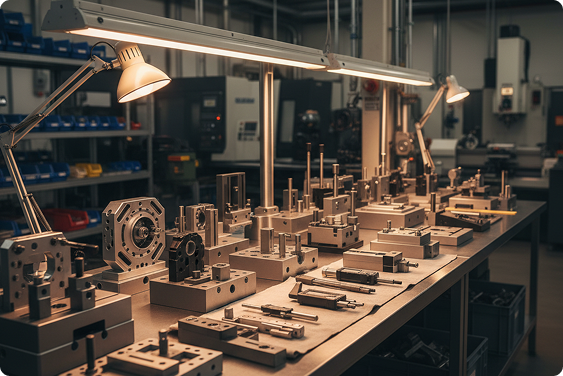
If the part moves,
nothing else matters.
90% of the cycle-time and quality risk in any high-volume program is decided by the tooling — not the part. Yet tooling is what gets specified last, sourced cheapest, and revised most.
01
TOLERANCE STACK
Datums chosen for convenience — not for the metrology plan. By PPAP, the part passes; the gauge doesn't repeat.
02
CYCLE TIME
A fixture that looked fast in CAD takes 22 seconds to load on the line. The bottleneck just shifted upstream.
03
OPERATOR BURDEN
Fixtures designed by engineers who never operated one. RSI claims, missed cycles, and a high turnover line.
04
DESIGN DEBT
Every part variant gets a one-off fixture. Three years in, the floor is a museum of fixtures nobody understands.
Hardware that shows up
on day one of pilot.
Not deliverables. Not drawings. Working tooling — qualified, documented, and on the line when the operator clocks in.
A fixture that loads in 6 seconds.
Cycle-time-driven design from sketch one. Loading ergonomics, datum strategy, and clamping force optimised against your takt time — verified with operator-in-the-loop dry runs before metal is cut.
Tooling that PPAPs in one pass.
Datums, gauges, and check fixtures designed as a single metrology system. We co-author the control plan with your quality team — so first-article inspection is a non-event, not a project.
A fleet you can clone, not curate.
Modular base plates, parametric clamp libraries, standardised wear parts. Variant #14 takes 9 days, not 9 weeks. Your floor becomes a system — not a museum.
Tolerance budgets first.
Hero geometry second.
Most fixture houses start with the part. We start with the metrology plan, the takt time, and the cost-per-piece envelope — then back-solve the geometry that satisfies all three.
Audit
Decode the part
FAI history, GD&T review, takt-time audit, operator interviews. We surface the constraints that aren't on the print.
Architect
Pick datums, not parts
Datum strategy, locator scheme, clamping logic. We commit to a metrology system before anyone draws a flange.
Engineer
Build the math
FEA on critical members, clamping force calcs, repeatability budgets, and DFM walk-throughs with the toolroom.
Qualify
Prove it on iron
First-article on the floor with a senior toolmaker. We don't leave until your operator hits cycle on shift two.
From soft tools to hard,
from manual to lights-out.
One team, one CAD pipeline, one toolroom. No subcontracted handoffs that lose tolerance in translation.
Machining fixtures
Workholding for 3-axis, 5-axis, mill-turn — single-piece flow to high-mix pallet systems.
→
Assembly fixtures
Sub-assembly nests, indexed pallets, error-proof poka-yoke with sensor integration.
→
Welding & brazing fixtures
Thermally-isolated workholding with documented distortion budgets and weld-sequence logic.
→
Inspection & gauging
Hard gauges, coordinate-traceable check fixtures, GR&R-validated to your ASTM plan.
→
EOAT (end-of-arm tooling)
Robot grippers, vacuum heads, tool changers — designed against your robot's payload + reach envelope.
→
Press tools & dies
Progressive, transfer, and fineblanking — die development with strip layout and life modelling.
→
Injection mould tooling
Multi-cavity production moulds, MUD inserts, hot-runner integration — with mould-flow validation.
→
Composite layup tooling
Heated invar tools, shuttle frames, and cure-cycle-validated mandrels for autoclave & OOA.
→
Test & validation rigs
Bench rigs for life-cycle, pressure, vibration, and thermal — instrumented to your DAQ stack.
→
Process
Concept to first article
in eleven weeks.
Five stages. Four gate reviews. One owner per artefact. We publish the schedule on day one and update it weekly — your CFO sees the same plan your shop foreman does.
WK 1
STAGE 01
Discovery
Part audit, GD&T review, takt analysis, operator interviews. Constraint document signed by Ops, Quality, and PM.
ARTEFACT
Constraint document, audit report
WK 2–3
STAGE 02
Concept
2–3 fixture architectures with datum strategies. Trade-off matrix scored on cycle, cost, repeatability.
ARTEFACT
Concept package, decision matrix
WK 3–6
STAGE 03
Detailed design
Full CAD model, GD&T drawings, FEA, clamping calcs, DFM with toolroom. Co-authored control plan.
ARTEFACT
CAD package, control plan, FMEA
WK 6–9
STAGE 04
Build & assembly
Toolroom build, in-house QA, dry-run with rep parts. Iterate before the fixture leaves our floor.
ARTEFACT
Built fixture, dry-run report
WK 9–11
STAGE 05
First article & handover
On-site install, operator training, FAI on your line. We sign off only when shift-two cycle is hit.
ARTEFACT
FAI sign-off, training package, runbook
Frequently asked questions
Five working days from receipt of part files for a concept package. Eleven weeks from contract for first article. We commit dates in the PO.
Both. We design, build, and qualify in-house — our toolroom assembles and dry-runs every fixture before it ships, so you take delivery of working hardware, not just a CAD package.
Either. We take on single proof-of-concept fixtures and full multi-station fleets. The same datum and modular-base standards apply, so a one-off can scale to a fleet later without a redesign.
You do. On final payment, all CAD, drawings, GD&T, and control-plan documentation transfer to you in full — including native files — so any toolroom can maintain or replicate the fixture.
We don't sign off until it does. Cycle time is a contracted acceptance criterion — if first-article inspection misses takt, we revise the fixture at our cost until your operator hits cycle on shift two.
Yes. Every handover includes a runbook and spare-wear-part list, and we offer ongoing support, refurbishment, and replication for the life of the program.
What Our Clients Say

“We rolled out a unified analytics platform on a practical timeline. Production planners finally see the same numbers as finance, and weekly review meetings are shorter.”
Manufacturing operations leader
United States
“The machine learning models DevWorks built for us reduced unplanned downtime on critical lines. The team delivered clear documentation and stayed involved through the first production release.”
Engineering leader
United States
“They helped us move off spreadsheets without breaking existing workflows. Our engineers adopted the dashboards faster than any prior IT project we have run.”
Data and operations leader
United States
“Predictive maintenance alerts now reach supervisors before equipment fails, so the plant can act on issues before they become stoppages.”
Plant operations leader
United States
“The data pipeline work was thorough and practical. We get near real time visibility into inventory and supplier performance without adding manual reporting steps.”
IT leader
United States