


What Are the Key Components of IoT Implementation Services?
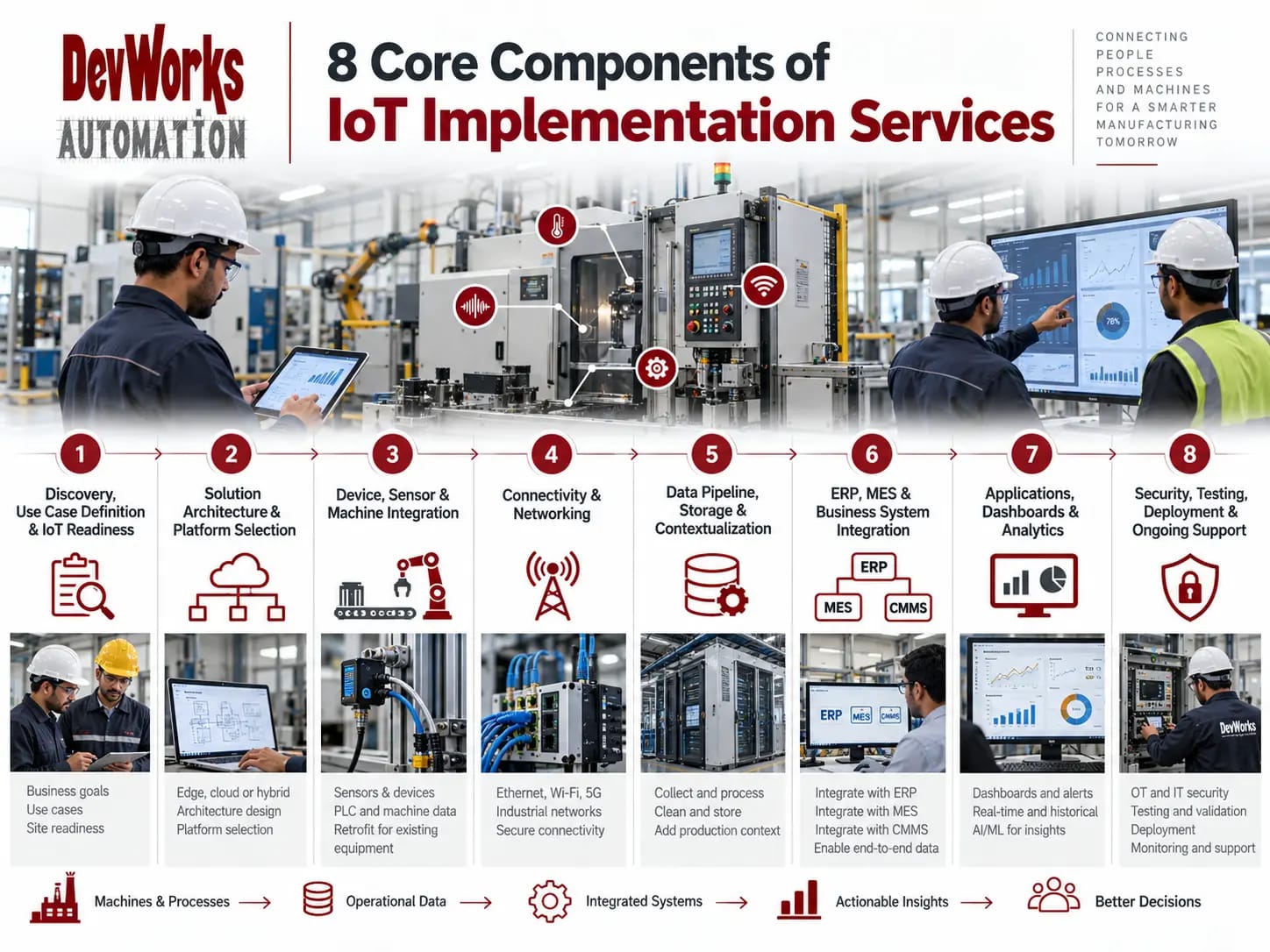
IoT implementation services cover the process of turning connected equipment into a usable operational system. They typically include use-case planning, solution architecture, sensor and machine integration, connectivity, data pipelines, business-system integration, applications and analytics, security, deployment, and ongoing support.
By DevWorks Automation Team · October 9, 2026 · 15 min read
Most manufacturers do not struggle to buy sensors. They struggle to turn sensor readings into decisions that people on the plant floor can trust. That is the gap IoT implementation services are designed to close.
IoT implementation services cover the process of turning connected equipment into a usable operational system. They typically include use-case planning, solution architecture, sensor and machine integration, connectivity, data pipelines, business-system integration, applications and analytics, security, deployment, and ongoing support.
This guide explains what a complete IoT implementation engagement covers, what each stage delivers, how the pieces fit together, what drives cost, how long implementation can take, and how to choose a partner that can take a project beyond the pilot stage.
The 8 Core Components of IoT Implementation Services
Complete IoT implementation usually covers eight connected areas. The exact mix depends on the plant, the equipment already in place, the business problem, and the systems that need to use the data.
- Discovery and use case definition: agreeing on the business problem, the success metric, and the first assets to connect.
- Solution architecture: choosing sensors, gateways, edge or cloud processing, protocols, data models, and the IoT platform.
- Device and sensor integration: installing or retrofitting sensors and connecting PLCs and existing machine controllers.
- Connectivity and networking: setting up wired or wireless networks and the protocols that move data reliably.
- Data pipeline and platform setup: collecting, cleaning, storing, and contextualizing data so it can support a decision.
- System integration: connecting IoT data to ERP, MES, CMMS, quality, planning, and other business systems.
- Applications, dashboards, and analytics: giving operators, engineers, maintenance teams, and managers the views and alerts they need.
- Security, testing, deployment, and support: protecting devices and data, validating the solution, and maintaining it as the system grows.
A plant with modern PLCs may need more integration and data work than hardware work. A plant with older equipment may need sensor retrofits before useful data can be collected. The implementation should be shaped around the operational problem, not around a predetermined list of technologies.
At DevWorks Automation, the same principle guides our IoT consulting and data management services: connect what matters first, then turn the resulting data into decisions the operations team can act on.
The goal is not to collect the most data. The goal is to collect the right data and make it useful where decisions are made.
How IoT Implementation Works From Machine to Business Decision
A useful way to understand an IoT implementation is to follow the data from the physical asset to the decision it supports:
Machine or sensor → gateway or controller → network → edge or cloud processing → data platform → business system → dashboard, alert, or action
The physical layer captures signals such as temperature, vibration, current, cycle counts, machine state, or process parameters. Connectivity moves that data reliably. The data layer cleans and contextualizes it. Business integration connects it to production, maintenance, quality, planning, or customer workflows. The final application gives people a decision, alert, or action they can use.
This is why an IoT project is rarely just a sensor-installation project. The value depends on what happens to the data after the sensor produces it.
1. Discovery, Use Case, and IoT Readiness
Discovery defines the business problem the IoT system must solve and the number that proves it worked. Good examples include unplanned downtime on a bottleneck machine, scrap on a specific line, or energy use per unit produced.
A discovery phase typically delivers:
- A ranked list of use cases with a clear owner for each
- An asset and data inventory covering machines, PLCs, controllers, and existing systems
- A baseline measurement of the problem before anything is connected
- A scoped pilot plan with success criteria and a go or no-go decision point
- A view of the people, systems, and processes affected by the project
This is often the stage that determines whether an IoT project becomes a useful production system or remains a technology pilot. Industry surveys have repeatedly found that many companies struggle to move IoT projects from pilot to full rollout, a pattern McKinsey described as "pilot purgatory" (IndustryWeek). A clear use case, measurable target, and ownership model help reduce that risk.
For example, if a bottleneck press loses production time because of short, repeated stoppages, the first IoT project does not need to connect the entire plant. It can focus on that press, measure the loss consistently, and prove whether the collected data leads to a better decision.
2. IoT Solution Architecture and Platform Selection
Architecture decides how data moves from a machine to a decision and what the solution will cost to operate as it scales. The key choices include:
- Edge vs cloud processing: what is filtered or analyzed at the machine and what is sent to the cloud
- Platform: a commercial platform such as AWS IoT or Azure IoT, an industrial platform, or a custom build
- Protocols: for example OPC UA or MQTT on the plant side, and REST or event-driven APIs for applications
- Data model: how assets, lines, machines, and sites are named so data from different sources can be compared
- Scalability: how the same architecture can extend from a few assets to multiple lines or sites
Open industrial standards such as OPC UA can help reduce dependence on a single vendor (Microsoft). More importantly, the pilot should use an architecture that can support the intended production environment. A pilot built with throwaway tools can create unnecessary rework when the project scales.
3. Device, Sensor, and Machine Integration
This stage connects the physical equipment. In manufacturing, that usually means a mix of three situations:
- Modern machines with PLCs or controllers that already hold the required data and need a secure connection
- Legacy machines that need retrofit sensors for vibration, temperature, current, pressure, or cycle counts
- New connected products where sensors, firmware, and communications are designed into the product itself
The deliverable is a defined list of connected assets, the signals captured from each, and a sampling rate that matches the use case. Collecting every available signal at the highest frequency is rarely necessary and can increase storage, processing, and network costs.
4. Connectivity and Networking
Connectivity moves data reliably from the device to wherever it is processed. Options can include wired Ethernet, industrial Wi-Fi, cellular or private 5G, and lower-power wireless protocols such as BLE, ZigBee, Z-Wave, and LoRaWAN.
The right choice depends on distance, data volume, power availability, site layout, and the physical environment. Plants with heavy metal structures, heat, vibration, or difficult radio conditions may need industrial-grade networking hardware and a site survey before installation.
Connectivity also needs to be considered alongside security. A network that is technically available but poorly segmented or difficult to maintain can create operational and security problems later.
5. Data Pipeline, Storage, and Contextualization
Raw sensor values are rarely useful on their own. A reading of 78 means little until the system knows it is a bearing temperature on Press 4, during Job 1182, on the second shift.
This stage covers data ingestion, cleaning, time alignment, storage, and adding context from production systems. It is also where data ownership, quality rules, retention, and naming conventions are established.
Our article From Sensors to Decisions: IoT Data Operations Teams Will Trust covers these data quality and ownership patterns in more depth.
A reliable data model matters because the same signal may need to be compared across machines, shifts, products, or sites. Without consistent context, teams may have plenty of data but still struggle to answer a simple operational question.
6. Integration With ERP, MES, and Business Systems
Integration turns IoT from a monitoring screen into part of how the plant runs. Common connections include:
- ERP for orders, materials, costs, and other business records
- MES, or Manufacturing Execution Systems, for work orders, production counts, and quality records
- CMMS, or Computerized Maintenance Management Systems, to create maintenance work orders from machine condition
- Planning and scheduling tools to adjust commitments based on real production capacity
- Quality systems to connect process conditions with inspection and defect data
Without integration, operators may end up watching one more dashboard while still re-keying information into the systems that drive decisions. DevWorks builds these links through custom software development and API work so connected data can reach the systems teams already use.
7. Applications, Dashboards, and Analytics
Once data is reliable and contextualized, it needs to be presented differently for different roles:
- Operators: simple status, alarms, and next actions at the machine
- Maintenance teams: condition trends, early warnings, and asset history
- Engineers: detailed historical data for root cause analysis
- Managers: Overall Equipment Effectiveness (OEE), throughput, downtime, and trend summaries across lines or sites
Analytics and machine learning can add predictive capabilities once the data foundation is reliable. Possible uses include failure prediction, quality prediction, and delivery-risk signals.
DevWorks supports this layer through data analytics and machine learning development. Mobile and web applications, including APIs and software interfaces for connected devices, can be part of the same delivery.
8. Security, Testing, Deployment, and Ongoing Support
Security should be designed into the implementation from the beginning rather than added after devices are connected. Core practices include device identity and authentication, encrypted communication, network segmentation between IT and plant systems, access control, and a disciplined process for firmware and software updates.
For industrial environments, the ISA/IEC 62443 series of standards provides a key reference for securing industrial automation and control systems across their lifecycle. Our article IoT Security and Uptime for Connected Plants explains how these practices support resilient connected operations.
Testing should cover data accuracy, integrations, alerts, failure conditions, security controls, and user workflows before production rollout. After go-live, support can include device monitoring, updates, data quality checks, user feedback, and scaling to new lines or sites.
An IoT system without an owner and support plan tends to lose value as sensors drift, networks change, software ages, and business requirements evolve.
IoT Platform vs Implementation Partner vs In-House Team
An IoT platform is software. An implementation service is the work of making that software, your machines, and your business systems function together. Most manufacturers need both, and the practical decision is who will own the integration work and long-term capability.
| Approach | Best for | Strengths | Limitations |
|---|---|---|---|
| Platform only (self-configured) | Teams with strong in-house IT and OT skills | Lower upfront services cost and full control | Integration, security, and data modeling remain with your team |
| Implementation partner | Plants that need results without building a new internal team | Experience across architecture, integration, deployment, and scale-up | Requires clear ownership and a knowledge-transfer plan |
| Fully in-house build | Companies treating IoT as a core long-term capability | Deep process knowledge and no external dependency | Hiring, longer ramp-up, and higher risk on first projects |
| Hybrid (partner plus internal owner) | Many mid-size manufacturers | Partner delivers while the internal team learns and owns the system | Roles and responsibilities must be defined from day one |
In practice, a hybrid model can work well when a plant wants outside implementation experience but also wants long-term internal ownership. A partner can handle architecture, integration, and early deployments while an internal owner builds the knowledge needed to run and extend the system.
When internal capacity is the main constraint, DevWorks also offers staff augmentation with engineering and IT professionals who work inside the client team.
Where IoT Implementation Pays Off in Manufacturing
The best first IoT projects usually target one expensive, measurable problem on a small number of assets. These use cases are common starting points because the data can often be captured clearly and the business value can be measured:
| Use case | What gets connected | Decision it supports |
|---|---|---|
| Machine monitoring and OEE | Run, idle, and fault signals; cycle counts | Where capacity is lost and why |
| Condition monitoring and predictive maintenance | Vibration, temperature, motor current | When to inspect or service equipment before failure |
| Quality monitoring | Process parameters linked to inspection results | Which conditions lead to scrap or rework |
| Energy and utilities monitoring | Power meters, compressed air, water | Where energy cost per unit can be reduced |
| Asset and material tracking | RFID, BLE tags, and location data | Where WIP, tools, and materials are right now |
| Connected products | Sensors and firmware in the product you sell | Service, warranty, and product improvement insight |
What Should You Connect First?
Start with the constraint. Connect the machine or line that limits output, causes the most downtime, creates the most scrap, or has another measurable operational impact. Prove value there, then expand.
Trying to instrument the whole plant on day one can produce a large amount of data without creating enough useful decisions. A smaller project makes it easier to validate the data, involve operators, measure ROI, and improve the architecture before scaling.
Our article Industrial IoT Visibility Without Boiling the Ocean walks through this phased approach. If you are not sure your processes are ready, 5 Signs Your Manufacturing Workflows Are Ready for Automation is a useful self-check.
IoT data also becomes more valuable when it feeds decisions beyond the machine. DevWorks case studies such as Shop-Floor KPIs Leaders Actually Use and Order Visibility That Stops Late Shipments Before They Happen show how connected operational data can become scorecards and early risk signals.
How Much Do IoT Implementation Services Cost?
IoT implementation cost depends mainly on project scope, the condition of existing equipment, the connectivity environment, and how deeply the system must integrate with business software. There is no reliable single price for every plant because a small machine-monitoring pilot is very different from a multi-site implementation with ERP, MES, CMMS, and custom applications.
The main cost drivers are:
- Number of assets and sites to connect
- Equipment age and whether retrofit sensors are needed
- Connectivity and network infrastructure requirements
- Platform licensing and data-volume charges
- Integration depth, especially two-way ERP, MES, or CMMS integration
- Custom applications for operators, maintenance teams, or customers
- Security, compliance, testing, and commissioning requirements
- Ongoing monitoring, updates, support, and scaling
The most reliable way to estimate cost is to plan in stages: discovery, pilot, validation, scale-up, and optimization. A focused pilot on a few assets gives you real information about hardware, integration effort, data quality, and business value before you commit to a full rollout.
To get a scoped estimate for your plant, you can request a quote from DevWorks Automation.
How Long Does an IoT Implementation Take?
A focused pilot on a few machines is often scoped to show results within about 90 days, while multi-line or multi-site rollouts take longer depending on integration and network readiness. Cisco, for example, recommends ending a pilot and trying another use case if it shows no results after 90 days (Cisco).
Timelines vary with the number of assets, equipment condition, integrations, network readiness, security requirements, and internal approvals. A typical implementation progresses through these stages:
| Stage | What happens |
|---|---|
| Discovery | Define the business problem, assets, data, stakeholders, and success criteria. |
| Pilot | Connect a limited number of machines or one production area and validate the use case. |
| Validation | Test data quality, integrations, user workflows, security, and measurable business impact. |
| Scale-up | Extend the solution to additional machines, lines, departments, or sites. |
| Optimization | Add advanced analytics, automation, or predictive capabilities once the underlying system is stable. |
The right timeline is therefore less about a fixed number of days and more about how many systems, assets, and decisions the implementation needs to support.
Common IoT Implementation Mistakes
- Starting with technology instead of a problem: Buying sensors before defining the decision they need to support.
- Building a pilot that cannot scale: Using tools or architecture that must be replaced before production use.
- Ignoring data context: Collecting values without linking them to machines, jobs, products, and shifts.
- Skipping integration: Leaving IoT data in a separate dashboard that nobody checks.
- Treating security as a final step: Retrofitting security after devices are already on the network.
- No owner after go-live: Systems without an internal owner and support plan lose trust quickly.
- Leaving operators out: If the people on the floor do not find the system useful, adoption stalls.
How to Choose an IoT Implementation Partner
The right IoT implementation partner understands both the plant floor and the business systems around it, not just devices and cloud platforms. Use these questions to compare providers:
- Do they start with your business problem? A strong partner asks about downtime, scrap, capacity, quality, or energy before recommending hardware.
- Can they cover the full stack? Sensors, connectivity, data, integration, applications, and security should fit together.
- Do they understand manufacturing systems? Ask about experience connecting PLCs, ERP, MES, CMMS, and quality systems.
- Are they platform-neutral? A partner tied to one platform may recommend it whether or not it fits the use case.
- How do they handle security? Ask how they approach device identity, network segmentation, updates, testing, and industrial security practices.
- What happens after the pilot? Look for a defined path to production and scale, not just a demonstration.
- What deliverables will you receive? Useful deliverables include an architecture diagram, asset and data inventory, integration map, testing plan, documentation, and support model.
- Who owns the system long term? Clear documentation, knowledge transfer, and support options matter as much as the build itself.
DevWorks Automation works with manufacturing and engineering teams across the United States and Canada. IoT projects are planned alongside the workflows they affect, including engineering, planning, production, quality, and shipping. That context helps connected data support decisions instead of adding another disconnected screen.
Key Takeaways for Successful IoT Implementation
IoT implementation services include far more than installing sensors. A complete engagement connects discovery, architecture, device integration, connectivity, data pipelines, business-system integration, applications, security, deployment, and long-term support.
The strongest projects start with one measurable operational problem, connect the assets that matter most, build a pilot that can scale, and connect the resulting data to the systems where people already make decisions.
Planning an IoT project for your plant? DevWorks Automation can help you identify the right first use case, assess your equipment and systems, and map a practical path from pilot to production. Explore our IoT consulting and data management services or book a consultation to talk through your requirements.
Frequently Asked Questions
What is IoT implementation?
IoT implementation is the process of planning, connecting, integrating, testing, and supporting sensors, devices, networks, and software so physical equipment produces usable operational data. In manufacturing, the goal is to turn machine and process data into better decisions about downtime, quality, energy, maintenance, and capacity.
What is the difference between IoT consulting and IoT implementation?
IoT consulting focuses on strategy, including use cases, architecture, platform choice, readiness, and the business case. IoT implementation is the hands-on delivery, including device connections, data pipelines, system integration, applications, testing, deployment, and ongoing support. Many providers, including DevWorks, offer both as part of one engagement.
Do I need new machines to implement IoT?
No. Existing equipment can often be connected. Modern machines may expose useful data through their PLCs or controllers, while older machines can be retrofitted with external sensors for signals such as vibration, temperature, power draw, and cycle counts.
What is the difference between IoT and IIoT?
IIoT, or Industrial IoT, is IoT applied to industrial environments such as factories, utilities, and process plants. It places stronger emphasis on reliability, industrial networking, real-time or near-real-time data, integration with control and business systems, and operational technology security.
How do I measure the ROI of an IoT project?
Measure a baseline before the project starts, then track the same metric after go-live. Typical measures include unplanned downtime hours, OEE, scrap rate, maintenance cost, energy per unit, throughput, or another metric tied directly to the original business problem. Compare the improvement with implementation, licensing, infrastructure, and support costs over the expected life of the system.
Can IoT data be used for AI and predictive analytics?
Yes, once the data is clean, consistent, and linked to production context. IoT data can support predictive maintenance, quality prediction, process optimization, and demand or delivery risk models. A reliable data foundation should come before advanced models because poor input data can produce poor predictions.