


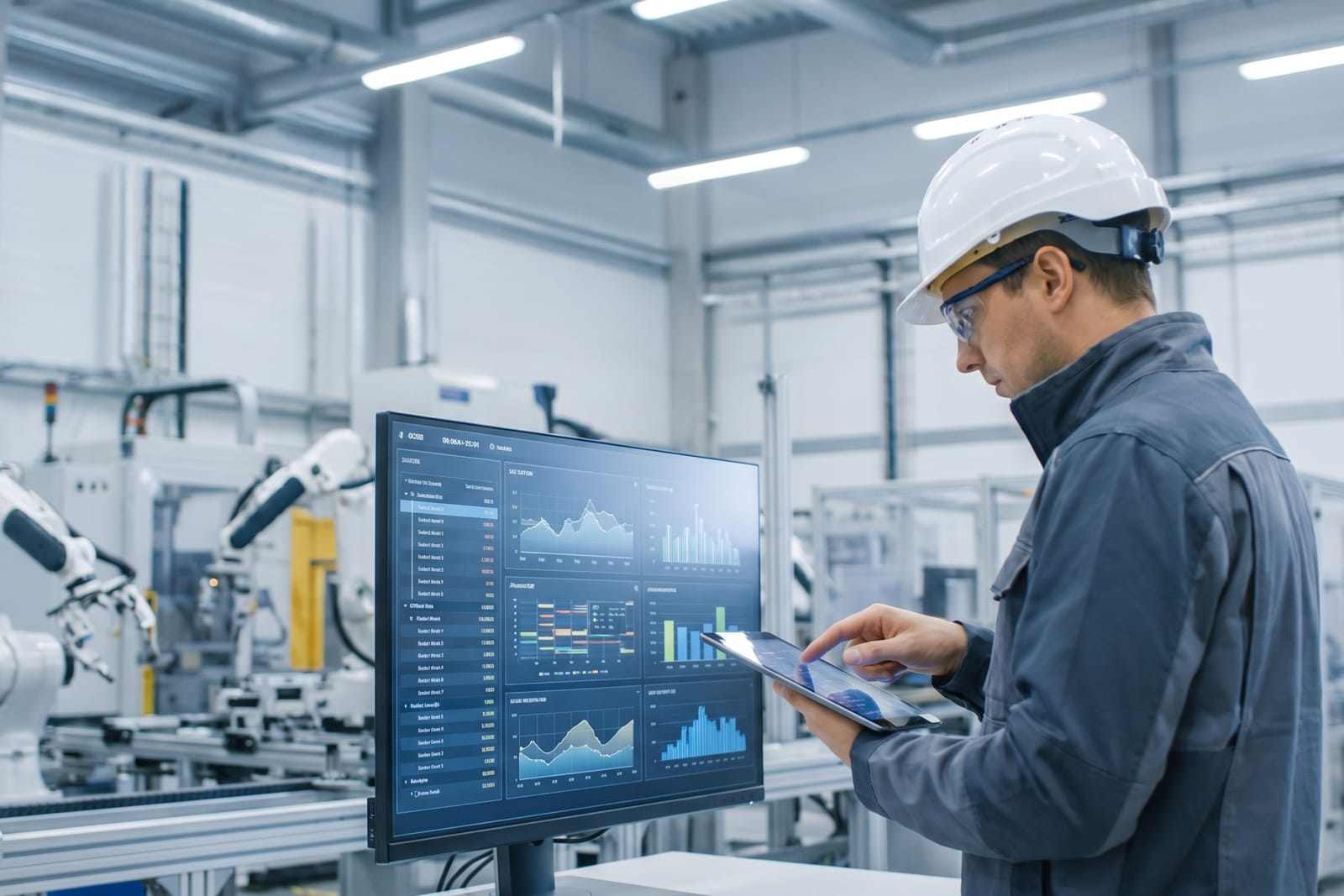
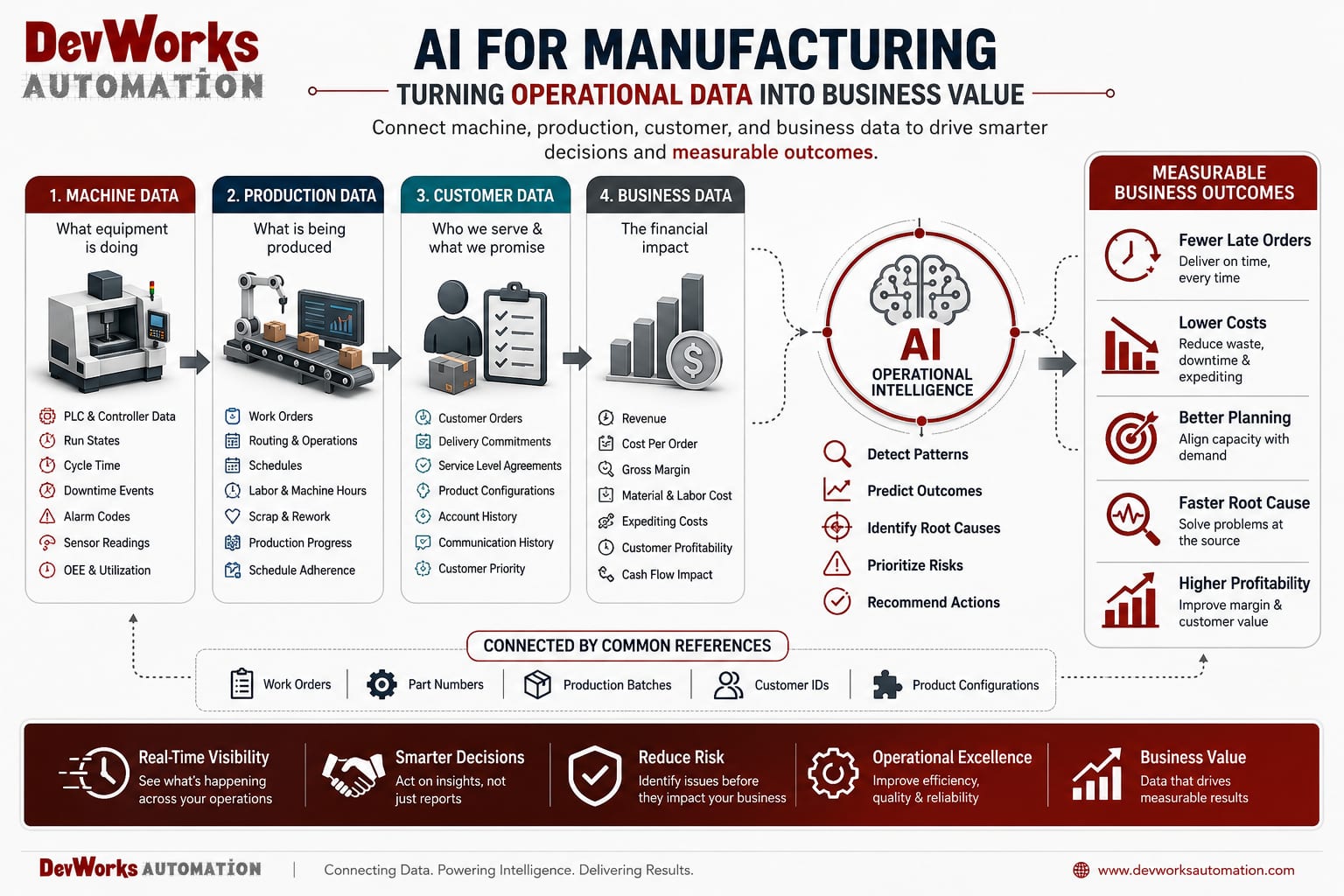
AI in manufacturing is most valuable when it connects operational data to business decisions. Machine systems capture equipment performance, MES platforms track production, CRM systems hold customer information, and ERP platforms manage orders, costs, and revenue. When these systems remain disconnected, valuable insights stay trapped in separate databases and reports.
AI does not create business value simply by analyzing more data. The first step is connecting and contextualizing data across systems. Once the data is aligned, AI can identify patterns, predict risks, and help manufacturers make faster decisions based on the full operational picture.
What Is Operational Intelligence in Manufacturing?
Operational intelligence in manufacturing is the use of connected operational data, analytics, and AI to understand what is happening, predict what is likely to happen, and support better business decisions.
Instead of looking at machine performance, production schedules, customer commitments, and financial results separately, operational intelligence connects them.
For example, a machine experiencing repeated downtime is an operational issue. But when that downtime is connected to a production order, customer delivery commitment, and order margin, it becomes a business risk that can be prioritized. This is where data analytics and AI create measurable value, not just visibility.
Four Types of Manufacturing Data AI Can Connect
Manufacturers are not short on data. The challenge is that it lives in four largely disconnected layers, each answering a different question.
Machine data comes directly from equipment, PLCs, controllers, and sensors: run states, cycle times, downtime events, alarm codes, temperature and vibration readings, and OEE metrics. On its own, it tells you what happened at the machine. Connected to production and business data, it reveals why the event matters.
Production data provides the operational context: work orders, routing steps, schedules, labor and machine hours, scrap and rework, and schedule adherence from your MES. Connecting this with machine signals helps identify where delays, quality problems, or capacity constraints are developing.
Customer data adds business context: orders, delivery commitments, service-level agreements, product configurations, and account history from your CRM. A two-hour machine delay does not carry the same weight on every order. If it affects a high-priority order with a critical delivery date, the operational event becomes significantly more important.
Business and financial data from your ERP (revenue, cost per order, gross margin, material and labor costs, expediting costs, and customer profitability) provides the economic context. Connected to production events, it turns "what happened" into "what did it cost the business."
AI becomes more useful when these four layers are connected through common references such as work orders, part numbers, production batches, customer IDs, or product configurations.
How AI Turns Connected Data Into Decisions
Once operational data is connected, AI and machine learning models can analyze relationships across thousands of machines, orders, production records, and customer accounts. The goal isn't another dashboard. It's better decisions.
- Detecting patterns: identifying recurring relationships that are difficult to find through manual reporting, such as a machine configuration or supplier component that repeatedly precedes a specific quality issue
- Predicting outcomes: flagging orders trending toward late shipment, machines showing early signs of decline, or capacity falling behind upcoming demand
- Identifying root causes: comparing operational events across machines, products, shifts, suppliers, and customers to shorten the path from problem to source
- Prioritizing risk: weighing customer importance, delivery deadline, order value, and margin so the highest-impact issues surface first
- Recommending action: turning multiple disconnected signals into a single decision a planner can act on, such as flagging an at-risk order along with its likely cause and business impact
From Operational Signals to Business Outcomes
| Operational Signal | AI Analysis | Business Outcome |
|---|---|---|
| Machine downtime | Detect recurring downtime patterns | Higher equipment availability |
| Production delays | Predict order risk | Improved on-time delivery |
| Rising scrap | Identify process and machine relationships | Lower cost of poor quality |
| Capacity constraints | Compare capacity with demand | Better production planning |
| Quality defects | Correlate defects with production conditions | Faster root-cause analysis |
| Customer commitments | Combine orders with production status | More accurate delivery dates |
| Cost changes | Connect production activity to order margin | Better profitability decisions |
This is the difference between data visibility and operational intelligence: reports describe what already happened, while connected AI surfaces what's likely to happen next and what it will cost if nothing changes.
Example: Understanding the True Cost of a Machine Delay
Late-order prediction is one well-known use of connected manufacturing data, a pattern we've covered in detail in how AI predicts late orders before they happen in manufacturing. A less obvious use is understanding what a delay actually costs once it happens.
Consider a machine that experiences a two-hour stoppage. On its own, that's a maintenance log entry. Connected to production and financial data, it becomes something more specific:
The Connected View:
- Machine data: Two-hour unplanned stoppage on a CNC cell
- Production data: The stoppage pushes a high-mix work order behind its routing schedule
- Customer data: That work order belongs to a strategic account with a service-level commitment
- Business data: Recovering the schedule requires overtime and expedited shipping, cutting order margin by double digits
Individually, each system shows a fact. Connected, they show that this specific two-hour stoppage carries a real, quantifiable cost to a specific account: information a planner can use to decide whether to absorb the delay, reroute the job, or authorize the overtime before the cost is locked in.
What Is OEE and Why Does It Matter?
Overall Equipment Effectiveness (OEE) measures equipment performance across availability, performance, and quality. OEE is useful on its own, but its business value becomes clearer when it's connected to production and financial data, for example, knowing not just that OEE dropped, but which orders are affected, how much capacity is being lost, and what the cost impact is likely to be.
What This Looks Like in Practice
A practical starting point does not require connecting every system in the organization. A manufacturer might begin with just work orders, machine data, and customer commitments: enough to answer which orders are at risk, why, which machines are contributing, and what the business impact is likely to be.
Once that foundation is in place, the same data infrastructure can support additional agentic AI applications: predictive maintenance, capacity planning, quality prediction, scrap reduction, and customer profitability analysis. Each new use case builds on the same connected data rather than starting from scratch.
Do You Need to Replace Your ERP or MES?
No. Manufacturers generally do not need to replace existing ERP or MES systems to connect operational data. The objective is integrating what you already have, whether that's PLCs, SCADA, MES, ERP, CRM, quality systems, or IoT platforms, using common references like work orders, part numbers, and customer IDs to establish relationships between them.
Getting Started Without Building a Large Data Science Team
Most manufacturers already have much of the data required for their first AI use case; it just isn't connected yet. A practical starting point usually comes down to four questions:
- What business problem are we trying to solve?
- Which data sources contain the information required?
- How can those sources be connected and contextualized?
- Which AI model or analytical approach can support the decision?
A focused use case, such as identifying at-risk customer orders, typically provides a clearer path to measurable value than attempting to connect every data source at once.
DevWorks Automation helps manufacturers connect machine, production, customer, and business data into AI-powered analytics and predictive solutions, built around the systems you already run, not a generic platform.
Have manufacturing data spread across PLCs, MES, ERP, CRM, and production systems? Talk to DevWorks Automation about connecting those systems and building AI-powered solutions around your existing operations.
Frequently Asked Questions
What is operational data in manufacturing?
Operational data is information generated by the day-to-day operation of a manufacturing business: machine and sensor data, production and work order data, quality information, customer orders, and cost and revenue data stored across PLCs, MES, CRM, and ERP platforms.
How does AI use manufacturing data?
AI uses connected manufacturing data to identify patterns, predict outcomes, and support operational decisions. For example, combining machine downtime, production progress, and delivery commitments to flag orders likely to ship late.
What manufacturing data should be connected first?
Start with the data required to solve a specific problem. For an at-risk order use case, that typically means work orders, production progress, machine status, and customer delivery dates before expanding further.
Do we need to replace our ERP or MES to use AI?
No. Existing ERP, MES, CRM, and PLC systems can usually be integrated without replacement, connected through common references such as work orders, part numbers, and customer IDs.
How is AI different from a manufacturing reporting dashboard?
A dashboard mainly shows what already happened. Connected AI analyzes relationships across systems to surface what's likely to happen next, such as late orders, capacity constraints, or rising costs, before it becomes a problem.
How can AI reduce manufacturing costs?
By identifying downtime patterns, predicting production problems, reducing scrap and rework, improving scheduling, and connecting operational inefficiencies to their financial impact.
What is a realistic first AI project for a manufacturer?
A focused use case with a measurable outcome, such as predicting late orders, identifying recurring downtime causes, or forecasting production capacity, is usually the best starting point.