


How Generative AI Is Changing Engineering and Manufacturing Workflows
See where generative AI is already delivering value in engineering and manufacturing workflows, and where most AI pilots stall before they scale.
By DevWorks Automation Team · August 24, 2026 · 14 min read
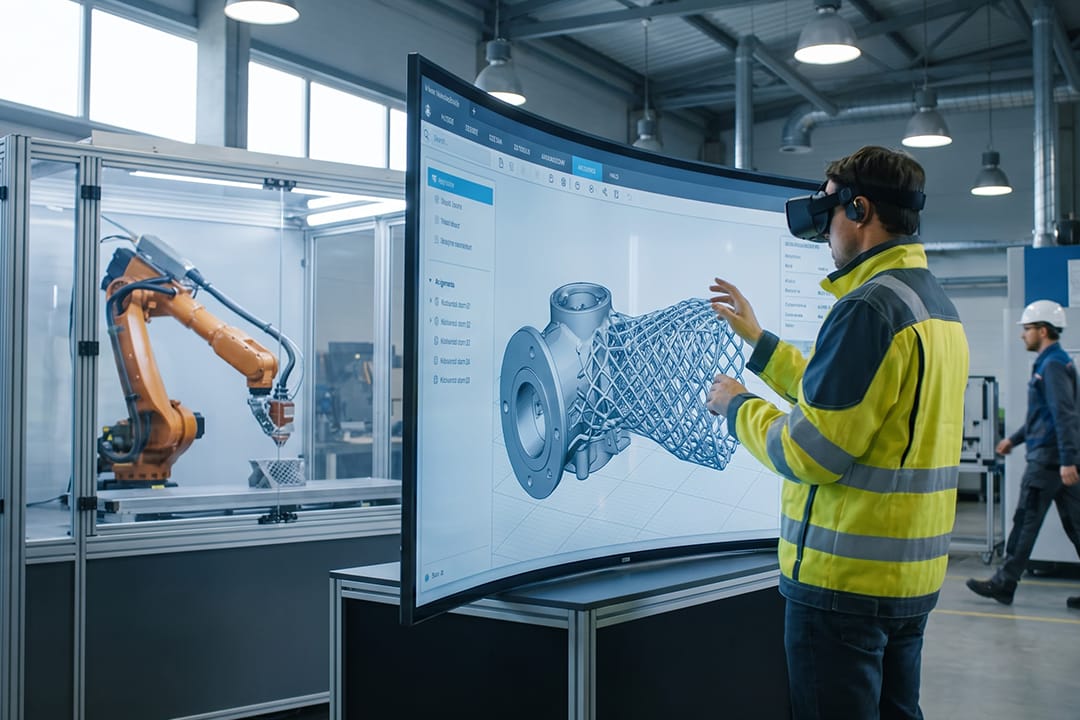
Generative AI is moving past chatbots and demos. In engineering and manufacturing, its real value is showing up in documentation, CAD-to-BOM workflows, product configuration, knowledge retrieval, quality, and maintenance, not in replacing validated engineering rules.
For an engineering leader, whether generative AI is powerful isn't really the question anymore. The more useful question is:
Where can generative AI create measurable value without compromising engineering accuracy, product quality, or human control?
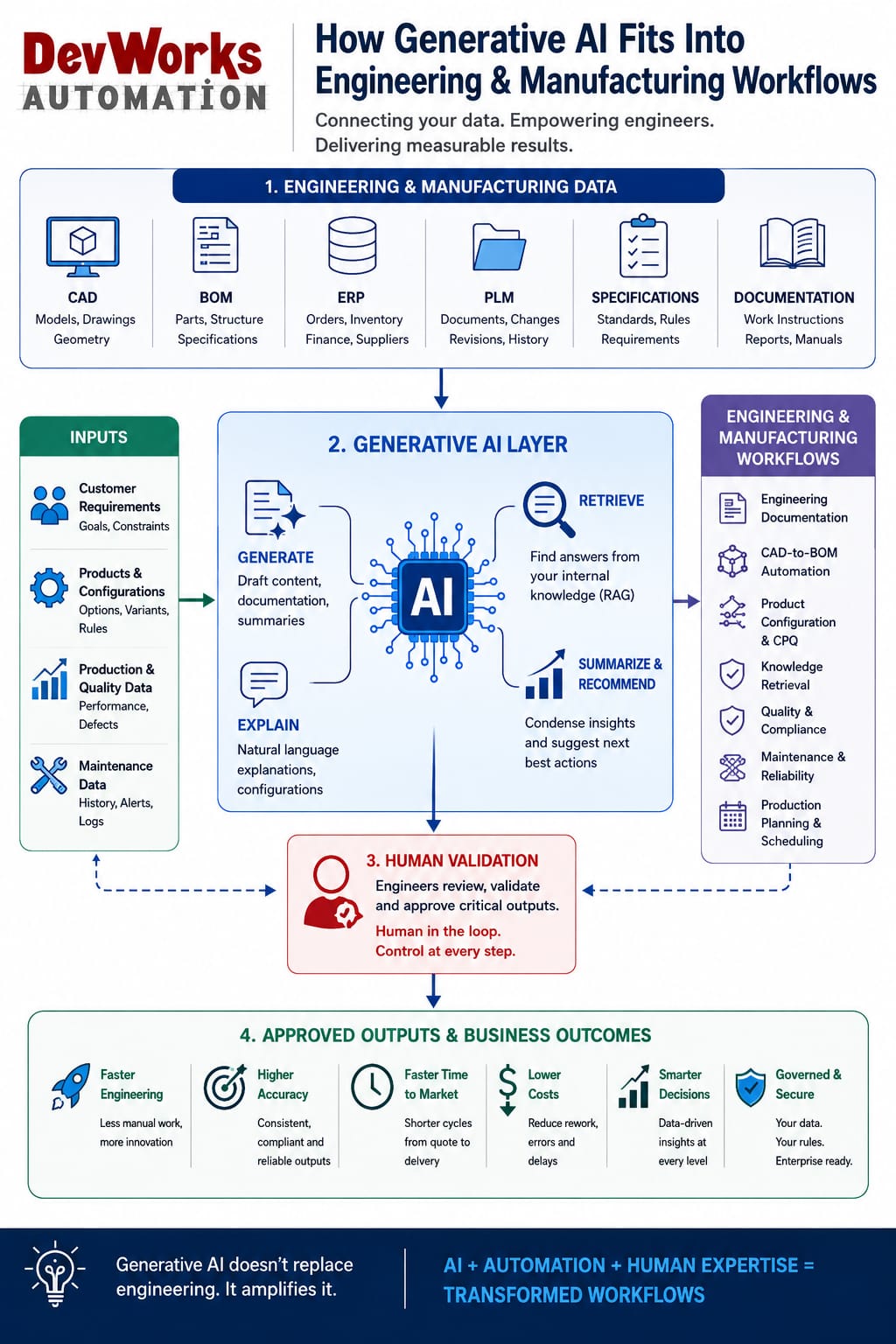
The strongest opportunities show up where AI can work alongside the data and automation manufacturers already depend on: CAD models, BOMs, ERP records, PLM systems, product rules, and engineering documentation. Generative AI is good at drafting, explaining, summarizing, and retrieving. It should not be the thing replacing validated engineering rules or removing human approval from decisions that require engineering judgment.
This article covers where generative AI is delivering practical value in engineering and manufacturing today, why so many AI pilots never make it past the proof-of-concept stage, and how to connect generative AI to the automation you already have instead of bolting it on top. It reflects the same practical approach DevWorks Automation brings to every engineering and manufacturing engagement.
At a Glance
| Question | Answer |
|---|---|
| What is generative AI in manufacturing? | AI that generates, summarizes, explains, or retrieves information using an organization's own manufacturing and engineering data. |
| Where is it most useful today? | Documentation, knowledge retrieval, product configuration, CAD-to-BOM workflows, quality, and maintenance. |
| Does it replace engineers? | No. Engineers stay responsible for validating and approving engineering-critical output. |
| What data does it need? | Depending on the workflow: CAD, BOM, ERP, PLM, specifications, and documentation. |
| Where should manufacturers start? | A repetitive, measurable, low-risk workflow that already has accessible data and defined rules. |
| What's the biggest implementation risk? | An ungrounded model producing a plausible but incorrect answer about your specific products or processes. |
What "Generative AI in Manufacturing" Actually Means
Generative AI gets used as a catch-all term, which is part of why it's hard to evaluate. In an engineering and manufacturing context, it's worth separating three distinct capabilities, because the risk profile and ROI timeline are different for each.
Generative Documentation
AI drafts engineering specs, drawing notes, work instructions, quality reports, and configuration explanations from existing engineering data. The workflow looks like: engineering data → AI-generated draft → engineer review → approved documentation. The engineer stays responsible for the final version; the AI just removes the blank-page step.
Generative Design Assistance
AI proposes design alternatives, configurations, or process parameters within engineer-defined constraints. This is different from letting AI make final engineering decisions independently. The strongest implementations keep validated rules and human approval in the loop.
Retrieval-Augmented Generation (RAG)
RAG connects a model to an organization's own CAD data, BOMs, PLM records, ERP information, and documentation, so engineers can ask plain-language questions and get answers grounded in the company's actual products, with a traceable source, instead of the model's general training knowledge.
Documentation and retrieval use cases are lower risk and typically show value in weeks. Design assistance and shop-floor autonomy need tighter guardrails and a longer runway. Most manufacturers seeing real value started with the first two.
Where Generative AI Is Already Delivering Measurable Results
Engineering Documentation and Drafting
Engineers spend a disproportionate share of their week writing things down: drawing notes, revision summaries, work instructions, compliance documentation. Generative AI can produce a first draft from existing engineering data in seconds, with an engineer reviewing rather than authoring from scratch.
This is also where some of the more credible enterprise results show up. Enterprise search deployments have reportedly helped Siemens cut engineering research time by roughly 30%, since engineers can query prior designs, material specs, and known failure modes in natural language instead of searching manually. Similar deployments at Airbus and Alstom point the same direction: the value isn't the AI writing anything creative, it's the AI finding and synthesizing information engineers already had, just couldn't reach fast enough.
CAD-to-BOM Automation
This is the layer where generative AI stops being a chatbot and starts being infrastructure. Rules-based engineering automation platforms like the ones we deploy through DriveWorks Implementation already generate configured CAD models, drawings, and BOMs from predefined product logic. Generative AI adds a layer around that deterministic automation, generating the drawing explanations, BOM summaries, and justifications that used to require manual write-up on every custom order.
| Stage | What Handles It |
|---|---|
| Customer requirements → product configuration | Rules-based configurator |
| Configuration → CAD model, drawings, BOM | Deterministic CAD automation |
| CAD/BOM output → plain-language explanation, summary, justification | Generative AI |
| Explanation → final sign-off | Engineer review |
| Approved data → downstream systems | ERP / PLM |
Generative AI doesn't replace engineering automation here. It makes existing automation easier to interact with. For configured and engineer-to-order manufacturers, this is usually the highest-ROI starting point, because the rules already exist in the CAD model. See how this works in our CAD Design Automation, BOM Automation & Validation, and Engineering Workflow Automation services.
Product Configuration and CPQ Intelligence
Configurators already use rules to determine which option combinations are valid. Generative AI can make that interaction more useful for non-technical users, explaining why a configuration is invalid instead of just returning an error, or suggesting the nearest valid option. The underlying rule engine still determines what's actually valid; the generative layer just makes the interaction more natural. Learn more about Product Configuration Automation and DriveWorks Configurator Services, including how DriveWorks Live extends this to browser-based configuration for sales and customers.
Engineering Knowledge Retrieval
Engineering organizations accumulate enormous amounts of information over time. The challenge usually isn't the absence of knowledge, it's finding the right piece of it quickly: a prior design, a material spec, a known failure mode, a past customer configuration. A RAG-based assistant lets engineers ask in natural language and retrieve relevant information from approved organizational sources, rather than relying on folder structure and institutional memory. This works alongside our broader Data Analytics capabilities, which help turn scattered engineering and production data into a single, searchable source of truth.
Quality and Predictive Maintenance
Generative AI works well alongside predictive models here, without replacing them. The pattern: a predictive model identifies an issue, generative AI explains it. A vibration-monitoring model flags an abnormal trend; the generative layer turns that into a human-readable maintenance recommendation an engineer can act on. The prediction itself still comes from the analytical model, built through our Machine Learning Development work, not the language model.
Real-world deployments back this up directionally. BMW has used AI to cut production scheduling time by roughly 30% through dynamic, real-time scheduling that accounts for machine availability, workforce shifts, and supply chain constraints. The pattern holds across most credible case studies: gen AI drafts and explains; a separate predictive or optimization model does the forecasting. We've seen the same pattern on the ERP and production-scheduling side too; see How AI Predicts Late Orders Before They Happen in Manufacturing for a closer look.
Manufacturing Planning
Planning involves machine availability, workforce, material availability, and routing constraints. AI can help interpret this information and explain the reasoning behind a recommended adjustment in plain language, while a planner reviews and approves before anything changes. The pattern here matters more than the specific use case: AI recommends, humans validate, systems execute.
Agentic Workflows on the Shop Floor
The most advanced, and most overhyped, category: AI systems that monitor production data continuously and take low-risk actions directly, flagging a material reorder, proposing a schedule adjustment, surfacing an anomaly for review. This is real, but it's also where "generative AI" and "already in production" overlap the least. It requires more controls than a knowledge assistant: defined access, defined permitted actions, defined approval checkpoints, and audit logging. Our Agentic AI services are built around that same principle. Agents that act inside guardrails you define, not autonomous systems making unreviewed decisions on the floor.
Generative AI vs. Traditional Engineering Automation
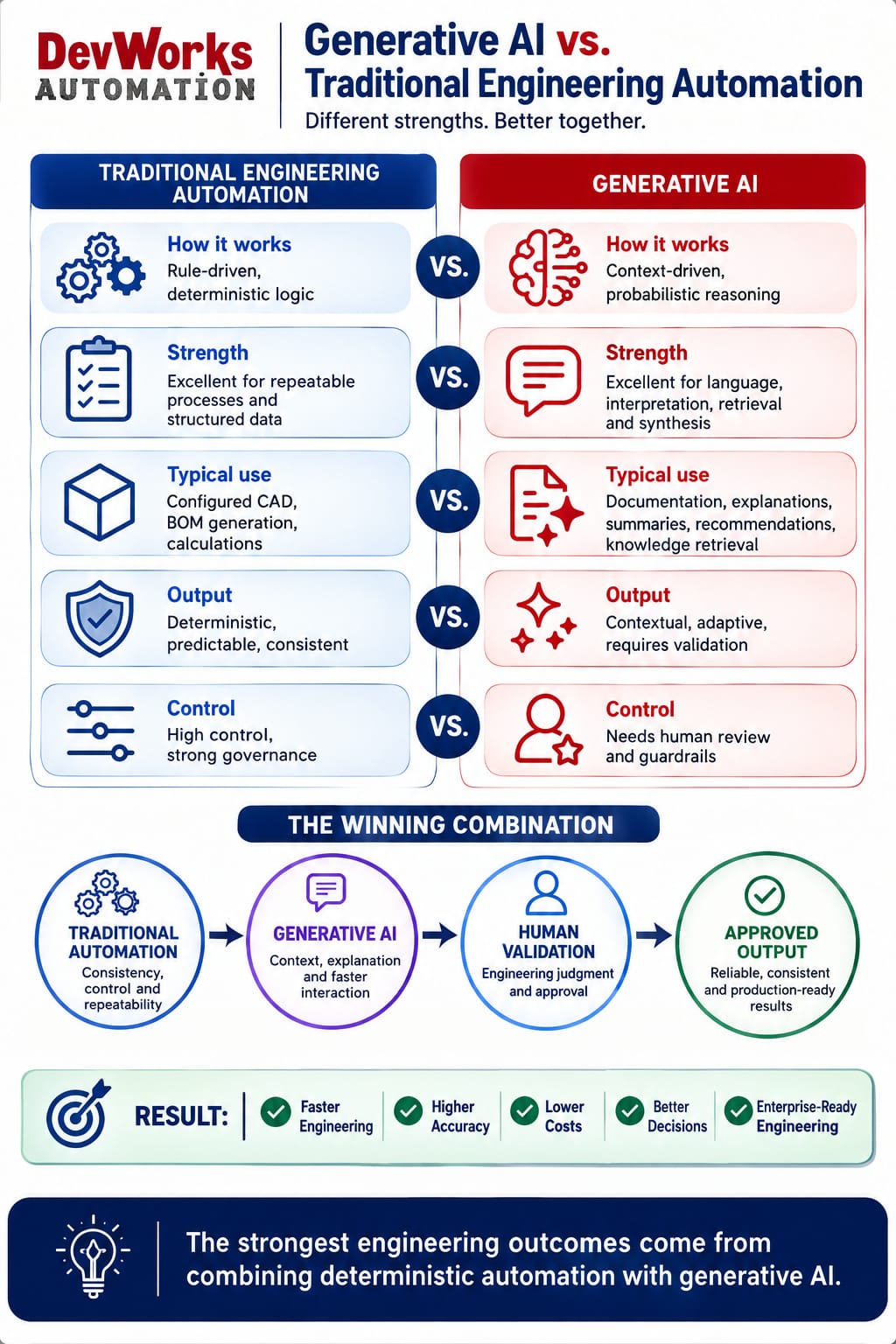
Generative AI and rules-based automation aren't competing technologies. They solve different parts of the workflow.
| Traditional Engineering Automation | Generative AI |
|---|---|
| Rule-driven | Context-driven |
| Deterministic output | Probabilistic output |
| Best for repeatable processes | Best for language, interpretation, and synthesis |
| Generates configured CAD | Explains configurations |
| Generates BOMs | Summarizes and analyzes BOM data |
| Executes predefined logic | Works from natural-language input |
| Highly predictable | Requires validation |
The strongest architecture combines both: deterministic automation provides control, generative AI provides flexibility and interaction. Manufacturers don't need to throw away the engineering automation they already depend on to get value from generative AI. The two layer on top of each other.
Why Most Generative AI Pilots Stall Before They Scale
If a generative AI pilot at your organization didn't go anywhere, it's rarely because the model wasn't capable enough. The recurring failure points are more mundane, and they're similar to the signs that a manual workflow is ready for automation in the first place.
- The AI wasn't grounded in your own data: A model that only knows what it was trained on will eventually produce a confident, wrong answer about your specific product line, tolerances, or supplier constraints. Production-ready deployments connect the model to your actual CAD, ERP, and PLM data through retrieval, not general training data alone.
- There was no integration layer: A tool that lives outside your CAD, MES, or ERP system creates another silo, not less manual work. If an engineer has to open the ERP, export data, paste it into a separate AI tool, then copy the answer back, most of the manual work still exists. Value shows up when output flows directly into the systems your team already uses.
- Nobody defined where human review stays mandatory: Manufacturing has real stakes: engineering changes, safety-critical parts, regulatory documentation. Deployments that scale are explicit about which outputs the AI can draft and which decisions a person has to approve before anything moves downstream.
- The pilot solved a demo problem, not a workflow problem: A slick proof-of-concept on sample data proves the model works. It doesn't prove it fits how your engineers actually build a quote, release a drawing, or close out a work order. That gap is usually where budget runs out before value shows up.
- The business metric was never defined: Without a measured baseline, hours per configuration, documentation time, BOM review time, quote turnaround, it's difficult to know afterward whether the deployment actually created value or just felt productive.
If your generative AI pilot can't point to the specific CAD file, ERP record, or spec document it drew from, it isn't ready for a production-critical workflow yet.
A Practical Framework for Adopting Generative AI
Getting from pilot to production follows the same four stages we use across our engineering automation work.
- Discover: Audit where engineers and planners lose time to documentation, search, or manual translation between systems. Identify which workflows already have well-defined rules a generative layer can safely draft from.
- Architect: Design the integration: which CAD, ERP, or PLM data the model needs access to, how retrieval is grounded in your own documentation, and where human approval stays mandatory before output moves downstream.
- Build & Test: Validate against real product data and real edge cases, missing information, conflicting specs, invalid configurations, not sample data, with engineers reviewing output throughout.
- Deploy & Support: Roll out with the review checkpoints your teams actually need, then iterate as your product lines, documentation, and rules evolve.
This is the same discipline behind every Engineering Design Automation and Generative AI engagement: start with a workflow that has clear rules and low ambiguity, prove the value there, then expand.
How to Measure Generative AI ROI
Generative AI ROI should be measured against a specific workflow, not an abstract "AI transformation" goal. If a team spends four hours preparing a type of technical documentation and an AI-assisted workflow cuts that to one hour of review and finalization, the saving is three engineering hours per document.
Annual value ≈ hours saved per instance × number of instances per year × loaded engineering cost per hour
The full business case should also account for software, integration, implementation, and ongoing governance costs. That comparison is a far more useful basis for a funding decision than counting how many people logged into an AI tool.
What Shouldn't Be Automated Without Human Review
Generative AI can accelerate engineering workflows, but not every decision should be delegated to a language model. Human validation should stay central for:
- Safety-critical engineering decisions
- Final CAD and engineering change approval
- Released BOMs
- Regulatory and compliance documentation
- Production-critical changes
The more useful question isn't "how much of engineering can AI replace?" It's "which parts of the workflow can AI accelerate while keeping the right level of human control?"
What to Expect, Realistically
Generative AI in engineering and manufacturing isn't a switch you flip across the organization. Value depends on the workflow, the data, the integration, and how much human review stays in place. The manufacturers seeing real results are the ones treating it as an extension of the automation and integration work they were already doing: connected to CAD and ERP data, scoped to specific workflows, reviewed by engineers, not a general-purpose chatbot floating outside the systems teams already use.
The most practical path usually starts small, with documentation or knowledge retrieval, then expands into product configuration, BOM workflows, predictive maintenance, planning, and eventually controlled agentic workflows. Start with a measurable workflow, connect the right data, integrate with existing systems, keep human validation, measure results, expand.
This same shift, choosing tailored automation over generic subscription software, is also reshaping the wider competitive landscape; see The U.S. Manufacturing Comeback: Compete with Technology, Not Subscription Overhead for more on that trend.
Generative AI creates the most value when it's built on top of automation already grounded in your product rules and data, not layered over disconnected manual processes. If your engineering team is still hand-writing documentation your CAD data already contains, that's usually the highest-leverage place to start.
Visit the DevWorks Automation homepage to explore our full range of engineering and manufacturing automation services, or contact us to find where generative AI fits into your engineering and manufacturing workflows.
Frequently Asked Questions
What is generative AI in manufacturing?
Generative AI in manufacturing uses AI models to generate, summarize, explain, or retrieve engineering and production information from an organization's own data and product rules, rather than tools that autonomously replace engineering judgment.
Is generative AI different from the automation DevWorks already builds with DriveWorks?
Yes. Rules-based configurators like DriveWorks generate exact CAD models, drawings, and BOMs from defined logic. Generative AI adds a layer on top, drafting the documentation, explanations, and summaries around that output, without changing the validated rule set underneath.
Does generative AI replace engineers in CAD-heavy workflows?
No. In every deployment pattern we recommend, generative AI drafts and an engineer reviews. Models are scoped to draft documentation, explain configurations, or summarize predictive output, not to make unreviewed engineering decisions.
What data does generative AI need for engineering workflows?
It depends on the use case, but commonly CAD data, BOMs, PLM records, ERP information, specifications, and engineering documentation. RAG-based systems work best when this data is searchable in one place rather than scattered across disconnected folders.
What's the fastest way to see ROI from generative AI in an engineering workflow?
Start with documentation and BOM generation for configured products, since the underlying rules already exist in your CAD and configurator data. This typically shows measurable time savings faster than design-assistance or shop-floor agent use cases.