


How AI Helps Manufacturers Make Faster, Smarter Decisions
How AI turns production, quality, maintenance, and supply chain data into earlier warnings and better decisions, before small issues become expensive ones.
By DevWorks Automation Team · August 19, 2026 · 13 min read
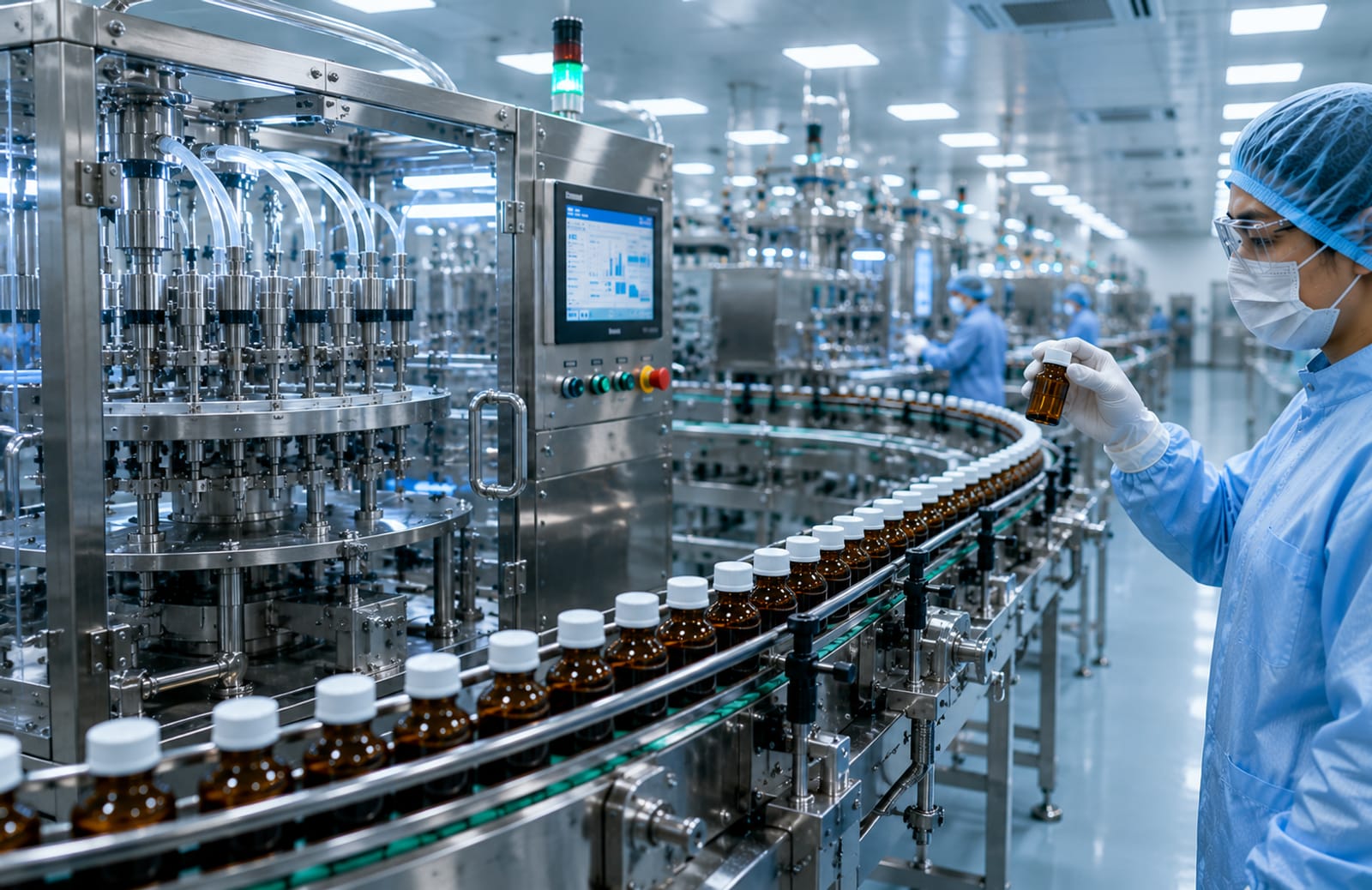
AI helps manufacturers make faster, smarter decisions by turning production, quality, maintenance, inventory, and supply chain data into actionable insight. Instead of waiting for problems to surface, manufacturers can use AI to detect patterns, predict risk, and act before a small issue turns into an expensive disruption.
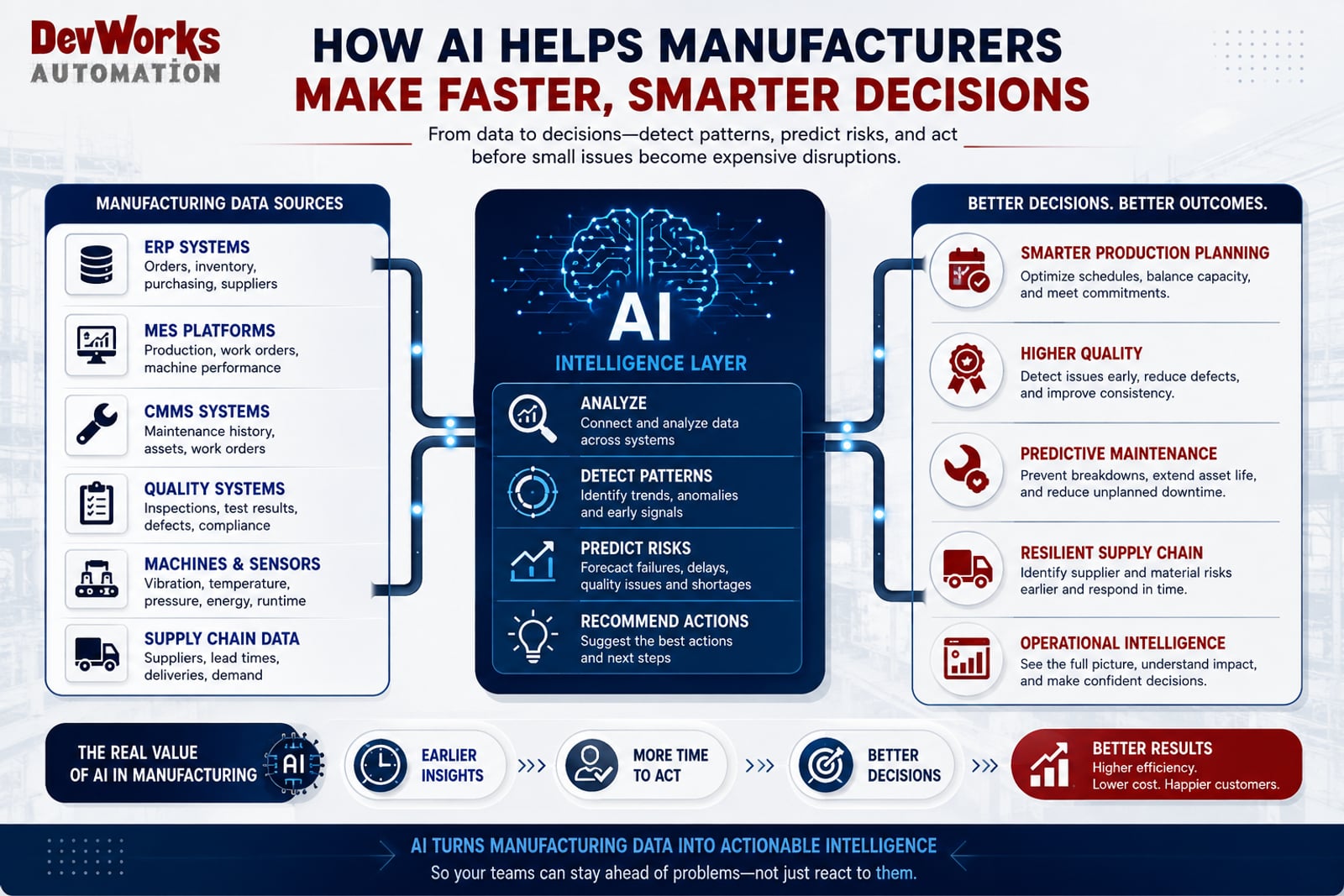
Manufacturing operations generate enormous amounts of data every day. ERP systems track orders and materials. MES platforms capture production activity. CMMS systems record equipment maintenance. Quality systems store inspection results, and machines and sensors generate real-time operating data around the clock.
The challenge isn't a lack of data. It's turning that data into the right decision at the right time.
DevWorks Automation provides that intelligence layer across these systems, helping planners, engineers, quality teams, maintenance managers, and operations leaders see what is happening, what is likely to happen next, and where to act.
How Does AI Help Manufacturers Make Better Decisions?
AI analyses historical and real-time manufacturing data to identify patterns, detect anomalies, predict potential problems, and support operational decisions. In manufacturing, it's particularly useful for:
- Production planning and scheduling
- Quality monitoring and defect prediction
- Predictive maintenance
- Supply chain risk management
- Demand and inventory forecasting
- Operational intelligence
- Real-time decision support
Rather than replacing experienced manufacturing professionals, AI gives them earlier, more complete information so they can make the call with more confidence and more lead time. If you're still weighing whether your operation is ready for this shift, our post on 5 signs your manufacturing workflows are ready for automation is a good place to check.
How AI Turns Manufacturing Data into Decisions
AI-powered manufacturing solutions typically follow a simple process: Collect → Connect → Analyse → Predict → Act.
Data from ERP, MES, CMMS, quality systems, machines, and sensors is brought together and analysed. AI models identify patterns that are difficult to catch manually, patterns that can predict production delays, equipment failures, quality issues, or material shortages before they occur. The final step turns that prediction into something a person can use: an alert, a recommendation, a dashboard update, a schedule change, or a maintenance work order. Our data analytics services are built around exactly this pipeline, turning raw operational data into dashboards and predictive models teams can act on.
Predicting a problem is only half of it. The value is in giving someone enough time to do something about it.
AI for Production Planning and Scheduling
Production schedules are usually built around standard cycle times, expected machine availability, material lead times, and planned capacity. The problem is that manufacturing rarely runs exactly to plan. Machines go down, materials arrive late, orders change, and a small disruption in one work centre quickly ripples into several downstream operations.
AI-powered production planning continuously compares the plan against what's happening, analysing factors such as actual machine capacity and historical throughput, current WIP and queue levels, material availability against confirmed supplier dates, order priorities and due dates, and known routing and production constraints.
Instead of working from a schedule that's outdated by lunchtime, planners get a dynamic view of production risk. If a critical component is likely to arrive late while a machine is already running near capacity, the model can flag the downstream impact early enough for planners to resequencing work, reallocate capacity, or adjust priorities, turning production planning from a reactive scramble into a proactive process. This is the same dynamic we covered in how AI predicts late orders before they happen in manufacturing, where engineering and production bottlenecks are flagged days before a ship date is missed.
AI for Manufacturing Quality Control
Quality problems typically develop well before they show up as a failed inspection or a customer complaint. A single defective part rarely reveals a pattern, but thousands of inspection records combined with machine settings, process parameters, and material batch data can reveal relationships no one would catch by reviewing parts one at a time.
AI-powered quality analytics can surface process drift, rising defect rates, tool wear patterns, material-related quality problems, scrap trends, and other anomalies in production parameters. It can also support root cause analysis by connecting a defect trend to a specific tool, machine condition, material lot, or process parameter, something that would otherwise take an engineer days of manual cross-referencing to find. This kind of pattern detection is a core part of our machine learning development work, where models are trained on a plant's own historical inspection and process data rather than generic industry benchmarks.
The goal isn't just catching a bad part. It's finding out why it happened early enough to stop the next nine.
AI for Predictive Maintenance
Unplanned downtime disrupts schedules, drives up maintenance costs, and delays customer orders. Traditional preventive maintenance runs on fixed intervals, servicing equipment after a set number of hours or cycles regardless of its actual condition.
Predictive maintenance works differently. AI models learn what normal behavior looks like for a given machine, using signals like vibration, temperature, pressure, energy consumption, motor performance, and cycle time, and flag deviations that suggest a developing problem. Getting these signals into a usable model usually starts with connecting the machines and sensors themselves; our IoT data management services handle that connection layer, so the equipment data reaches the model in real time. When something looks off, maintenance teams can investigate before the equipment reaches a critical failure point.
This is the progression from reactive maintenance, to preventive, to predictive, and eventually prescriptive, where the system doesn't just flag that something may fail, but recommends the specific action to take. The result is fewer emergency repairs, less overtime, and maintenance planning built on actual equipment condition instead of a calendar.
AI for Manufacturing Supply Chain Management
Supply chain disruptions rarely start on the shop floor. A supplier delay often exists days before its impact becomes visible in production, and by the time a material shortage shows up in the schedule, the remaining options, expedited freight, alternate sourcing, resequencing production, are already the expensive ones.
AI applied to supplier and production data can surface that risk earlier by tracking supplier delivery performance, historical lead-time variability, current purchase orders, inventory levels, demand forecasts, and how material timing lines up against the production schedule. If a supplier with a history of variable delivery times is now showing early signs of delay on a critical component, the model can flag the potential production impact while there's still time to expedite, substitute, or resequence around it.
AI doesn't remove supply chain uncertainty. It buys back the time needed to respond to it.
AI for Manufacturing Operational Intelligence
Production planning, quality, maintenance, and supply chain aren't separate problems, they're connected ones. A supplier delay affects the production schedule, which increases machine utilization, which puts more strain on equipment, which raises quality risk, which drives scrap and rework, which pushes out delivery. When each department only has visibility into its own systems, that chain of cause and effect stays hidden until the impact is already significant.
This is where operational intelligence, AI applied across connected data sources rather than within a single department, delivers the most value. It helps decision-makers understand not just what happened, but why it happened, what's likely to happen next, and what action would reduce the impact, catching the ripple effect while it's still one or two steps from the shop floor instead of after it's already there. Our agentic AI solutions are built for exactly this kind of cross-system monitoring, watching for these chains of cause and effect and surfacing them to the right person automatically.
Traditional Manufacturing Dashboards vs. AI-Powered Analytics
Traditional dashboards remain useful, but they're built to report what already happened. AI-powered analytics adds a layer on top of that.
| Traditional Analytics | AI-Powered Analytics |
|---|---|
| Shows what happened | Helps predict what may happen |
| Historical reporting | Predictive analysis |
| Manual investigation | Automated pattern detection |
| Static KPIs | Dynamic alerts and predictions |
| Reactive decisions | Proactive decisions |
| Human-driven analysis | AI-assisted analysis |
The goal isn't to replace the dashboard. It's to make the information already inside it actionable sooner.
What Data Does AI Need in Manufacturing?
Manufacturers often assume AI requires a completely new data infrastructure. In practice, most of what's needed already exists across ERP systems, MES platforms, CMMS systems, quality management systems, machine and sensor feeds, production schedules, inventory records, supplier information, bills of materials, historical orders, maintenance records, and inspection results.
The real challenge is connecting, cleaning, and contextualizing that information. A manufacturer can have excellent data sitting in five different systems, but if those systems don't talk to each other, someone still has to manually piece the story together. AI becomes far more valuable once it can work across connected sources instead of one system at a time, which is the same underlying challenge behind our engineering workflow automation work connecting design, quoting, and production systems.
Can AI Work With Existing ERP, MES, and CMMS Systems?
Yes. Manufacturers don't need to replace their existing ERP, MES, or CMMS platforms to introduce AI. It typically operates as an intelligence layer on top of what's already running, using ERP data for orders, inventory, purchasing, and suppliers; MES data for production, machine, and throughput information; CMMS data for maintenance history and equipment records; and quality system data for inspections and defects. Connecting these sources builds a far more complete picture of the operation than any one system provides on its own.
This "layer, not replace" approach also applies more broadly to how manufacturers modernize their software stack. We wrote about this shift in the U.S. manufacturing comeback: competing on technology doesn't have to mean paying for another subscription seat on top of the systems you already run. Our custom software development team builds that connective layer directly around your existing ERP, MES, and CMMS rather than asking you to migrate off them.
What Does AI Implementation Look Like in a Manufacturing Company?
Consider a manufacturer with an ERP holding customer orders and material data, an MES tracking production, and a CMMS logging equipment maintenance history. An AI solution can combine these datasets to identify orders at risk of running late, machines showing abnormal behavior, materials likely to arrive late, production bottlenecks, quality patterns, and maintenance risks, surfacing them as earlier alerts and recommendations instead of after-the-fact discoveries.
From there, a planner adjusts the production sequence. A maintenance engineer inspects a machine ahead of failure. A purchasing team expedites a critical component. A quality engineer investigates a process change before it produces more scrap. The technology delivers the prediction; the people closest to the operation still make the call.
DevWorks running predictive models like these typically see measurable improvement in on-time delivery and unplanned downtime within the first one to two quarters, not because the underlying process changed overnight, but because problems get caught while they're still cheap to fix.
When Is AI Not the Right Solution?
AI isn't automatically the answer to every manufacturing problem. A project can struggle when data quality is poor, important data isn't available, processes aren't clearly defined, there's insufficient historical information, nobody owns the resulting decision, the prediction can't be tied to an operational action, or the cost of a wrong prediction outweighs its potential benefit.
Successful AI implementation starts with a clear business problem, not a general desire to "use AI." The better starting point is identifying decisions that are currently slow, reactive, manual, or hard to make, and then asking whether AI can meaningfully improve that specific decision. Our AI consulting services exist for exactly that scoping conversation, before any model gets built.
How Manufacturers Can Start Using AI
Manufacturers don't need to transform every process at once. A practical approach starts with one measurable business problem:
- Identify a costly or time-consuming operational decision.
- Determine which data is needed to improve it.
- Connect the relevant data sources.
- Build a focused analytics or AI model.
- Deliver the prediction or recommendation to the people responsible for the decision.
- Measure the operational impact.
- Expand the solution to additional use cases.
A manufacturer might start with predictive maintenance and later expand into production scheduling, quality analytics, supply chain risk prediction, or demand forecasting. The objective isn't adding AI everywhere at once, it's making the decisions that matter most earlier, with better information behind them.
How DevWorks Automation Helps Manufacturers Apply AI
DevWorks Automation helps manufacturers turn existing operational data into practical AI and analytics solutions. Our approach connects data from systems such as ERP, MES, CMMS, and other manufacturing platforms to support predictive maintenance and machine learning models, production planning and operational dashboards, quality analytics, demand forecasting, supply chain analytics, agentic monitoring across connected systems, and custom AI applications.
Rather than asking manufacturers to replace the systems they already run, we build an intelligence layer that works with the existing technology environment and targets the specific decisions that matter most to the operation. The manufacturers who get the most value from AI aren't the ones with the most data, they're the ones who turn the data they already have into decisions made early enough to matter.
If you're exploring where AI could improve production planning, quality, maintenance, supply chain visibility, or operational decision-making, talk to the DevWorks Automation team.
Conclusion
AI is shifting manufacturing decision-making from reactive to proactive. Instead of waiting for a machine to fail, a supplier to miss a delivery, a quality problem to spread, or an order to go late, manufacturers can use AI to spot the risk earlier and give their teams time to respond.
The opportunity isn't adding artificial intelligence to a factory for its own sake. It's connecting the data manufacturers already have to the decisions they need to make. When production, quality, maintenance, and supply chain data work together, AI helps manufacturers move from knowing what happened to understanding what's likely to happen next, and deciding what to do about it. That's where AI becomes operational intelligence.
Ready to see where this fits your operation? Get in touch with DevWorks Automation explore the full range of engineering, software, and AI services we offer manufacturers.
Frequently Asked Questions
How is AI used in manufacturing?
AI is used in manufacturing for production planning, quality monitoring, predictive maintenance, demand forecasting, supply chain risk management, anomaly detection, and operational analytics.
How does AI improve production planning?
AI can analyze machine capacity, WIP, material availability, production constraints, historical cycle times, and order priorities to identify scheduling risks and support better production decisions.
Can AI predict machine failures?
AI-based predictive maintenance models can analyze machine, sensor, and maintenance data to identify patterns associated with equipment degradation and potential failures.
How does AI improve manufacturing quality?
AI can analyze inspection results, process parameters, machine conditions, and material data to identify patterns associated with defects, process drift, and increased scrap.
Can AI integrate with ERP and MES systems?
Yes. AI solutions can use data from ERP, MES, CMMS, quality, and other manufacturing systems to provide predictive analytics, alerts, and decision-support capabilities.
Does a manufacturer need to replace its ERP to use AI?
No, In many cases, AI can be implemented as an intelligence layer that works with existing ERP, MES, CMMS, and other operational systems.
What are the benefits of AI in manufacturing?
AI can help manufacturers detect problems earlier, improve production planning, reduce unplanned downtime, identify quality risks, improve supply chain visibility, and make faster operational decisions.
What data is needed for AI in manufacturing?
Depending on the use case, AI can use ERP, MES, CMMS, quality, production, inventory, supplier, machine, sensor, maintenance, and historical order data.